| GALAXIES (CLICK ON THUMBNAIL IMAGE FOR FULL-SIZE VIEW) |
NGC-7331: A bright, inclined spiral galaxy located in Pegasus. Visually, it resembles a small
version of the M-31 Andromeda Galaxy, and is approximately 10 X 2.5 minutes of arc in size.
It is inclined approximately 20 degrees from edge-on, and is inclined in position angle 163. Its
estimated distance from earth is 50 million light years. Also visible in this CCD image are 3
companion galaxies just above the center of 7331.
NOTE: This image was captured on August 31, 2014 and is an integration of ten 6-minute
exposures through the 11-inch Celestron at f/2 using HyperStar and the Starlight Express
SXVR-H694C camera. Captured and combined using Maxim DL 5 Pro, with post-processing
in Photoshop CS, Astro-tools, and Gradient XTerminator..
version of the M-31 Andromeda Galaxy, and is approximately 10 X 2.5 minutes of arc in size.
It is inclined approximately 20 degrees from edge-on, and is inclined in position angle 163. Its
estimated distance from earth is 50 million light years. Also visible in this CCD image are 3
companion galaxies just above the center of 7331.
NOTE: This image was captured on August 31, 2014 and is an integration of ten 6-minute
exposures through the 11-inch Celestron at f/2 using HyperStar and the Starlight Express
SXVR-H694C camera. Captured and combined using Maxim DL 5 Pro, with post-processing
in Photoshop CS, Astro-tools, and Gradient XTerminator..
NGC-891: A beautiful edge-on spiral galaxy in the constellation Andromeda. This is one of the most
classic examples of an edge-on spiral. Although it is very striking in appearance, visually it has very
low surface brightness, and requires a night with crystal-clear skies for the best view. Visually, it is
approximately 12 X 1 minutes of arc in size. It lies at a distance of approximately 40 million light
years, and is approximately 120,000 light years in width. NOTE: This image was captured on
11/7/2013, and is an integration of thirteen 7 minute exposures through the 11-inch Celestron at f/2
using the HyperStar system.The images were captured and combined in Maxim DL 5 Pro, with
additional post-processing in Photoshop CS, levels, curves & Gradient X-terminator.
classic examples of an edge-on spiral. Although it is very striking in appearance, visually it has very
low surface brightness, and requires a night with crystal-clear skies for the best view. Visually, it is
approximately 12 X 1 minutes of arc in size. It lies at a distance of approximately 40 million light
years, and is approximately 120,000 light years in width. NOTE: This image was captured on
11/7/2013, and is an integration of thirteen 7 minute exposures through the 11-inch Celestron at f/2
using the HyperStar system.The images were captured and combined in Maxim DL 5 Pro, with
additional post-processing in Photoshop CS, levels, curves & Gradient X-terminator.
NGC-6946: A large face-on spiral galaxy located in the constellation of Cepheus, close to its border with
Cygnus. Visually it is approximately 8 minutes of arc in diameter. This galaxy is one of the nearest
galaxies beyond the "local group" which includes M-31 in Andromeda. NGC-6946 lies at a distance of
about 10 million light years. It is inclined approximately 20 degrees from face-on and has four well
defined spiral arms. Its visual magnitude is 11, but its surface brightness is fairly low. The open cluster
NGC-6939 lies just to the NW, at the right edge of this image. It is only 10,000 light years distant, so this
image shows great depth of field.NOTE: Both images captured on August 12, 2015 and are 1 hour 40
minute exposures (ten 10 minute subs) through the 11-inch Celestron at f/2 using the HyperStar 3
imaging system and the Starlight Express SXVR-H694C camera. Guided, captured, combined using
Maxim DL 5 Pro. Post-processed using Photoshop CS2, Levels, curves, Gradient XTerminator and
Star Shrink.
Cygnus. Visually it is approximately 8 minutes of arc in diameter. This galaxy is one of the nearest
galaxies beyond the "local group" which includes M-31 in Andromeda. NGC-6946 lies at a distance of
about 10 million light years. It is inclined approximately 20 degrees from face-on and has four well
defined spiral arms. Its visual magnitude is 11, but its surface brightness is fairly low. The open cluster
NGC-6939 lies just to the NW, at the right edge of this image. It is only 10,000 light years distant, so this
image shows great depth of field.NOTE: Both images captured on August 12, 2015 and are 1 hour 40
minute exposures (ten 10 minute subs) through the 11-inch Celestron at f/2 using the HyperStar 3
imaging system and the Starlight Express SXVR-H694C camera. Guided, captured, combined using
Maxim DL 5 Pro. Post-processed using Photoshop CS2, Levels, curves, Gradient XTerminator and
Star Shrink.
NGC-7479: A beautiful barred spiral galaxy in the constellation of Pegasus. It is very easy to
locate in that it lies just 3 degrees due south of Alpha Pegasi (Markab). Visually this galaxy is
approximately 4 X 3 minutes of arc in size, and is about 11th magnitude. The accepted
estimate of its distance is approximately 50 million light years. On a perfect night, using the
11-inch Celestron SCT at 175X, the brightest spiral arm can be made out. NOTE: This image
was captured on 9/7/2013 and is an integration of ten 6-minute exposures through the C-11
at f/2 using HyperStar and the SXVR-H694C CCD imager. Captured and combined using
Maxim DL Pro v. 5.2. Post processed using Photoshop CS levels, curves, Gradient
X-terminator, and Astro Tools.
locate in that it lies just 3 degrees due south of Alpha Pegasi (Markab). Visually this galaxy is
approximately 4 X 3 minutes of arc in size, and is about 11th magnitude. The accepted
estimate of its distance is approximately 50 million light years. On a perfect night, using the
11-inch Celestron SCT at 175X, the brightest spiral arm can be made out. NOTE: This image
was captured on 9/7/2013 and is an integration of ten 6-minute exposures through the C-11
at f/2 using HyperStar and the SXVR-H694C CCD imager. Captured and combined using
Maxim DL Pro v. 5.2. Post processed using Photoshop CS levels, curves, Gradient
X-terminator, and Astro Tools.
NGC-7814: An SA-type spiral galaxy in the constellation Pegasus, located about 2 degrees NW of
Algenib (Gamma Pegasi). It is precisely edge-on, and has a narrow equatorial dust lane. This
galaxy lies at a distance of 76 million light years. Visually it is lens-shaped and is inclined from
northwest to southeast, and is approximately 6 X 2 minutes of arc in size. Also visible is the tiny 15th
magnitude galaxy IC-5381, located south of 7814. NOTE: This image was captured on 10/1/2013,
and is an integration of fifteen 6-minute exposures through the 11-inch Celestron at f/2 using
HyperStar and the SXVR-H694C imager. Captured and combined using Maxim DL 5 Pro.
Post-processed in Photoshop CS, levels, curves, and Gradient X-Terminator.
Algenib (Gamma Pegasi). It is precisely edge-on, and has a narrow equatorial dust lane. This
galaxy lies at a distance of 76 million light years. Visually it is lens-shaped and is inclined from
northwest to southeast, and is approximately 6 X 2 minutes of arc in size. Also visible is the tiny 15th
magnitude galaxy IC-5381, located south of 7814. NOTE: This image was captured on 10/1/2013,
and is an integration of fifteen 6-minute exposures through the 11-inch Celestron at f/2 using
HyperStar and the SXVR-H694C imager. Captured and combined using Maxim DL 5 Pro.
Post-processed in Photoshop CS, levels, curves, and Gradient X-Terminator.
M-33 (NGC-598): A large, face-on spiral galaxy located in the constellation of
Triangulum. M-33 is commonly called the "Pinwheel Galaxy". It is a member of the
local group of galaxies and is the closest galaxy to earth after M-31 in Andromeda. It
lies at a distance of about 3 million light years. The galaxy has a number of large
emission nebulae which appear reddish in the photograph, due to the wavelength of
ionized hydrogen. The largest of these nebula can be seen just above and slightly to
the right of the nucleus. This nebula is bright enough to have its own NGC number
(NGC-604) and is easily seen in an 8-inch telescope.
NOTE: This image was captured on September 22, 2014 and is an integration of
eight 6-minute sub exposures through the 11-inch Celestron at f/2 using the Hyper
Star 3 imaging system and the Starlight Express SXVR-H694C 1-shot color CCD
imager. Captured and combined in Maxim DL 5 Pro, post-processed using Photoshop
CS2, levels, curves, color balance and Gradient XTerminator.
Triangulum. M-33 is commonly called the "Pinwheel Galaxy". It is a member of the
local group of galaxies and is the closest galaxy to earth after M-31 in Andromeda. It
lies at a distance of about 3 million light years. The galaxy has a number of large
emission nebulae which appear reddish in the photograph, due to the wavelength of
ionized hydrogen. The largest of these nebula can be seen just above and slightly to
the right of the nucleus. This nebula is bright enough to have its own NGC number
(NGC-604) and is easily seen in an 8-inch telescope.
NOTE: This image was captured on September 22, 2014 and is an integration of
eight 6-minute sub exposures through the 11-inch Celestron at f/2 using the Hyper
Star 3 imaging system and the Starlight Express SXVR-H694C 1-shot color CCD
imager. Captured and combined in Maxim DL 5 Pro, post-processed using Photoshop
CS2, levels, curves, color balance and Gradient XTerminator.
 |
NGC-2903: A fine, bright, many-armed barred spiral galaxy which lies just SSW of Lambda
Leonis, the star at the tip of the "sickle" of Leo. Visually, this galaxy is 11 X 4 minutes of arc in
size, and glows at 9.7 magnitude. Good detail is visible in telescopes larger than 6-inches, and
spiral structure is easily seen in the C-11. NOTE: The LH image was captured on the morning of
January 29th, 2011, and is an integration of twenty-one 60 second exposures through the 11"
Celestron at f/2, using the HyperStar system. Also visible in this image is the small 16th
magnitude galaxy PGC-27115, the small faint blob about half way to the upper LH corner of
the image. Captured in Maxim DL, processed in Nebulosity v.2.2.8. The RH image was captured
on 1/23/2018 using the new widefield ZWO ASI071 widefield color imager. This widefield image
also shows galaxy NGC-2916 at the lower LH (east) side of the image.
Leonis, the star at the tip of the "sickle" of Leo. Visually, this galaxy is 11 X 4 minutes of arc in
size, and glows at 9.7 magnitude. Good detail is visible in telescopes larger than 6-inches, and
spiral structure is easily seen in the C-11. NOTE: The LH image was captured on the morning of
January 29th, 2011, and is an integration of twenty-one 60 second exposures through the 11"
Celestron at f/2, using the HyperStar system. Also visible in this image is the small 16th
magnitude galaxy PGC-27115, the small faint blob about half way to the upper LH corner of
the image. Captured in Maxim DL, processed in Nebulosity v.2.2.8. The RH image was captured
on 1/23/2018 using the new widefield ZWO ASI071 widefield color imager. This widefield image
also shows galaxy NGC-2916 at the lower LH (east) side of the image.
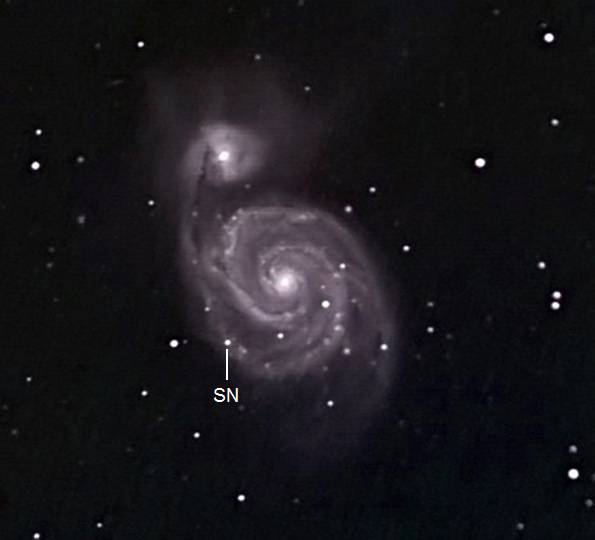
M-51 (NGC-5194): The famous "Whirlpool Galaxy", the first galaxy found to show a
spiral form. Discovered by Messier in 1773, the spiral pattern was first detected in
1845 by Lord Rosse with his giant 72-inch reflector in Ireland. M-51 is a type Sc spiral
(compact nucleus with well-developed spiral arms). Visually, it is 8th magnitude and
appears to be 10 X 6 arcminutes in size. Messier's description of a "nebula with two
nuclei" is due to the presence of the companion galaxy, NGC-5195, which appears at
the north end of a spiral arm which has been distorted by the tidal interaction with this
galaxy. The classification of this galaxy is uncertain. The M-51/NGC-5195 pair lies at a
distance of approximately 35 million light years from earth. The left hand image was
taken on 6/14/2020 and is an integration of twenty-one 4 minute sub-exposures,
through the C-11 at f/2 using HyperStar and the SXVR H694C 1-shot color imager.
The right hand image was taken on 6/4/2011 and is an integration of twenty
80-second exposures using HyperStar with the Orion Starshoot imager. It clearly
shows the type 2 supernova that erupted on one of the spiral arms on May 30, 2011.
Both exposures were guided, captured and combined using Maxim
DL5. Post processing was in PhotoShop CS2.
spiral form. Discovered by Messier in 1773, the spiral pattern was first detected in
1845 by Lord Rosse with his giant 72-inch reflector in Ireland. M-51 is a type Sc spiral
(compact nucleus with well-developed spiral arms). Visually, it is 8th magnitude and
appears to be 10 X 6 arcminutes in size. Messier's description of a "nebula with two
nuclei" is due to the presence of the companion galaxy, NGC-5195, which appears at
the north end of a spiral arm which has been distorted by the tidal interaction with this
galaxy. The classification of this galaxy is uncertain. The M-51/NGC-5195 pair lies at a
distance of approximately 35 million light years from earth. The left hand image was
taken on 6/14/2020 and is an integration of twenty-one 4 minute sub-exposures,
through the C-11 at f/2 using HyperStar and the SXVR H694C 1-shot color imager.
The right hand image was taken on 6/4/2011 and is an integration of twenty
80-second exposures using HyperStar with the Orion Starshoot imager. It clearly
shows the type 2 supernova that erupted on one of the spiral arms on May 30, 2011.
Both exposures were guided, captured and combined using Maxim
DL5. Post processing was in PhotoShop CS2.
M-95 (NGC-3351): A fine face-on barred spiral galaxy located in the center of the
constellation Leo, about 9 degrees east of Regulus (Alpha Leonis). M-95 is paired
with M-96, a spiral galaxy which lies 42 arcminutes to the east. M-95 has a bright
center and a pronounced central bar surrounded by circular spiral arms which gives
it a structure resembling the greek letter Theta. Visually, the galaxy is approximately
5 minutes of arc in diameter. Astronomers currently believe that this pair of galaxies
lie about 30 million light years from earth.
NOTE: This image was taken February 12, 2013, and is an integration of four
10-minute exposures through the 11-inch Celestron at f/2 using HyperStar. Images
were guided, captured and combined using Maxim DL 5 pro, with further post
processing using Photoshop CS.
constellation Leo, about 9 degrees east of Regulus (Alpha Leonis). M-95 is paired
with M-96, a spiral galaxy which lies 42 arcminutes to the east. M-95 has a bright
center and a pronounced central bar surrounded by circular spiral arms which gives
it a structure resembling the greek letter Theta. Visually, the galaxy is approximately
5 minutes of arc in diameter. Astronomers currently believe that this pair of galaxies
lie about 30 million light years from earth.
NOTE: This image was taken February 12, 2013, and is an integration of four
10-minute exposures through the 11-inch Celestron at f/2 using HyperStar. Images
were guided, captured and combined using Maxim DL 5 pro, with further post
processing using Photoshop CS.
M-101 (NGC-5457): The great face-on spiral galaxy in Ursa Major. One of the finest
examples of a face-on Sc type spiral galaxy. Discovered by Pierre Mechain in 1781
and added to Messier's catalog the same year. The distance to M-101 has been
disputed for many years, but after Alan Sandage & Gustav Tammann spent 10 years
with the Palomar 200" telescope studying faint Cephied variables in M-101, it was
believed to be about 15 million light years. Current studies of Cephied variables with
the Hubble Space Telescope have revised this distance as closer to 21 million light
years. At this distance, its apparent visual diameter of 26 arcminutes would
correspond to a diameter of over 170,000 light years. M-101 has a mass of over 16
billion suns! A truly impressive object.
NOTE: This image was captured on the evening of June 5, 2018 through the 11-inch
Celestron at f/2 using the HyperStar 3 imaging system. It is an integration of twelve
360 second exposures. Guided, captured & combined using Maxim DL 5 Pro, with
post-processing in Photoshop CS, levels & curves, sharpening, Carboni's Astronomy
Tools, GradientXTerminator and StarShrink.
examples of a face-on Sc type spiral galaxy. Discovered by Pierre Mechain in 1781
and added to Messier's catalog the same year. The distance to M-101 has been
disputed for many years, but after Alan Sandage & Gustav Tammann spent 10 years
with the Palomar 200" telescope studying faint Cephied variables in M-101, it was
believed to be about 15 million light years. Current studies of Cephied variables with
the Hubble Space Telescope have revised this distance as closer to 21 million light
years. At this distance, its apparent visual diameter of 26 arcminutes would
correspond to a diameter of over 170,000 light years. M-101 has a mass of over 16
billion suns! A truly impressive object.
NOTE: This image was captured on the evening of June 5, 2018 through the 11-inch
Celestron at f/2 using the HyperStar 3 imaging system. It is an integration of twelve
360 second exposures. Guided, captured & combined using Maxim DL 5 Pro, with
post-processing in Photoshop CS, levels & curves, sharpening, Carboni's Astronomy
Tools, GradientXTerminator and StarShrink.
M-64 (NGC-4826): A large, oval spiral galaxy of 8th magnitude, easily located just
1 degree ENE of the star 35 Comae Berenices. Its common name, "Black-Eye
Galaxy" derives from the large, dark, comma-shaped dust cloud which lies in the
central core just north and east of the bright nucleus. This dust cloud is difficult to
observe visually, requiring an 8-inch telescope and crystal clear skies to resolve.
Although M-64 lies just 8 degrees from the great Coma-Virgo galaxy cluster, it is a
foreground object, about 20 million light years from Earth, whereas the rest of the
cluster lies at three times that distance.
NOTE: This image was taken on the evening of April 6, 2011, and is an integration
of fifteen 70-second exposures through the 11-inch Celestron at f/2 using the
HyperStar system. The images were captured, combined and processed using
Nebulosity v. 2.2.8. Further post-processing using Photoshop CS, levels, curves
and layers. Finished image was filtered using NoiseWare.
1 degree ENE of the star 35 Comae Berenices. Its common name, "Black-Eye
Galaxy" derives from the large, dark, comma-shaped dust cloud which lies in the
central core just north and east of the bright nucleus. This dust cloud is difficult to
observe visually, requiring an 8-inch telescope and crystal clear skies to resolve.
Although M-64 lies just 8 degrees from the great Coma-Virgo galaxy cluster, it is a
foreground object, about 20 million light years from Earth, whereas the rest of the
cluster lies at three times that distance.
NOTE: This image was taken on the evening of April 6, 2011, and is an integration
of fifteen 70-second exposures through the 11-inch Celestron at f/2 using the
HyperStar system. The images were captured, combined and processed using
Nebulosity v. 2.2.8. Further post-processing using Photoshop CS, levels, curves
and layers. Finished image was filtered using NoiseWare.
NGC-4565: A spectacular edge-on galaxy in Coma Berenices and the largest of this type. It and NGC-891 in
Andromeda are the two most beautiful examples of the edge-on spiral. It is easily located, being just 1.7
degrees east of the bright star 17 Comae. It is a very interesting object for small to medium sized telescopes,
appearing as a bright narrow streak in a 6 inch reflector. Through the C-11 at 93 power, it fills almost 2/3 of
the field of view. The prominent equatorial dust lane is readily visible in telescopes of 6-inch diameter and up.
Radial velocity measurements indicate that NGC-4565 lies at a distance of about 45 million light years. At this
distance, its visual size of over 15 arcminutes in width would correspond to an actual diameter of over 100,000
light years. Also shown in this image are neighboring galaxies NGC-4562 to the right, and smaller IC-3671, to
the left of 4565's northern spiral arm.
NOTE: This image was captured on the morning of May 4,2014. It is an integration of fifteen 300 second
exposures through the C-11 at f/2 using HyperStar and the SXVR-H694C one shot color imager. Captured
using Maxim DL 5 Pro. Post-processing in Photoshop CS using levels, curves, and Gradient X-Terminator
Andromeda are the two most beautiful examples of the edge-on spiral. It is easily located, being just 1.7
degrees east of the bright star 17 Comae. It is a very interesting object for small to medium sized telescopes,
appearing as a bright narrow streak in a 6 inch reflector. Through the C-11 at 93 power, it fills almost 2/3 of
the field of view. The prominent equatorial dust lane is readily visible in telescopes of 6-inch diameter and up.
Radial velocity measurements indicate that NGC-4565 lies at a distance of about 45 million light years. At this
distance, its visual size of over 15 arcminutes in width would correspond to an actual diameter of over 100,000
light years. Also shown in this image are neighboring galaxies NGC-4562 to the right, and smaller IC-3671, to
the left of 4565's northern spiral arm.
NOTE: This image was captured on the morning of May 4,2014. It is an integration of fifteen 300 second
exposures through the C-11 at f/2 using HyperStar and the SXVR-H694C one shot color imager. Captured
using Maxim DL 5 Pro. Post-processing in Photoshop CS using levels, curves, and Gradient X-Terminator
M-100 (NGC-4321): The largest spiral galaxy in the Coma-Virgo galaxy cluster.
Discovered by Pierre Mechain in 1781 and by Messier a few weeks later. In
amateur telescopes, M-100 appears to be slightly less than 6 minutes of arc in
diameter. At its estimated distance of 40 million light years, this corresponds to
an actual diameter of 110,000 light years. Also visible in this image are two faint
companion galaxies, NGC-4328 (lower left) and NGC-4322 (left edge). At the
lower right corner of the image is NGC-4312. In all 9 galaxies are shown in this
frame.
NOTE: This image was captured on the evening of June 5, 2018, and is an
integration of thirteen 6-minute exposures through the C-11 at f/2 using the
SXVR-H694-C imager. Guided, captured and combined using Maxim DL5 Pro.
Post processed in PhotoShop CS, Carboni's astro tools, Gradient XTerminator.
Discovered by Pierre Mechain in 1781 and by Messier a few weeks later. In
amateur telescopes, M-100 appears to be slightly less than 6 minutes of arc in
diameter. At its estimated distance of 40 million light years, this corresponds to
an actual diameter of 110,000 light years. Also visible in this image are two faint
companion galaxies, NGC-4328 (lower left) and NGC-4322 (left edge). At the
lower right corner of the image is NGC-4312. In all 9 galaxies are shown in this
frame.
NOTE: This image was captured on the evening of June 5, 2018, and is an
integration of thirteen 6-minute exposures through the C-11 at f/2 using the
SXVR-H694-C imager. Guided, captured and combined using Maxim DL5 Pro.
Post processed in PhotoShop CS, Carboni's astro tools, Gradient XTerminator.
NGC-3628: A large dim edge-on spiral galaxy which forms a triangle with the brighter pair of galaxies, M-65 &
M-66 in Leo. NGC-3628 is quite large, with a visual size of over 12 minutes of arc in length. At its accepted
distance of 30 million light years, this would correspond to an actual diameter of over 90,000 light years. The
prominent dust lane is easily seen in small telescopes, although the overall surface brightness of this galaxy
is rather low. It appears somewhat ghostly in comparison to its neighbors, M-65 and M-66. NOTE: This image
was captured on the morning of May 4, 2014 and is an integration of eleven 300 second exposures through
the C-11 at f/2 using HyperStar and the SXVR-H694C color CCD imager. Captured and combined using
Maxim DL 5 Pro,Post processed in Photoshop CS, levels, curves, and Gradient X-Terminator.
M-66 in Leo. NGC-3628 is quite large, with a visual size of over 12 minutes of arc in length. At its accepted
distance of 30 million light years, this would correspond to an actual diameter of over 90,000 light years. The
prominent dust lane is easily seen in small telescopes, although the overall surface brightness of this galaxy
is rather low. It appears somewhat ghostly in comparison to its neighbors, M-65 and M-66. NOTE: This image
was captured on the morning of May 4, 2014 and is an integration of eleven 300 second exposures through
the C-11 at f/2 using HyperStar and the SXVR-H694C color CCD imager. Captured and combined using
Maxim DL 5 Pro,Post processed in Photoshop CS, levels, curves, and Gradient X-Terminator.
M-96 (NGC-3368): A large spiral galaxy of type Sa (large central region and tightly
wound spiral arms). Forms a pair with the fine barred spiral M-95, which lies just
42 minutes of arc to the west. These two galaxies, along with M-105 and its two
companions, form the so-called "Leo Group" of galaxies. M-96 is a fine sight in
small telescopes, and makes a nice pair with M-95.
NOTE: This image was taken March 1, 2017 is an integration of ten 6-minute
exposures through the 11-inch Celestron at f/2 using the HyperStar 3 imaging system
and the Starlight Express SXVR-H694C color CCD imager. Guided,captured and
combined using Maxim DL5 Pro. Post-processed using Photoshop CS, levels, curves,
AstroTools, Gradient X-Terminator and StarShrink.
wound spiral arms). Forms a pair with the fine barred spiral M-95, which lies just
42 minutes of arc to the west. These two galaxies, along with M-105 and its two
companions, form the so-called "Leo Group" of galaxies. M-96 is a fine sight in
small telescopes, and makes a nice pair with M-95.
NOTE: This image was taken March 1, 2017 is an integration of ten 6-minute
exposures through the 11-inch Celestron at f/2 using the HyperStar 3 imaging system
and the Starlight Express SXVR-H694C color CCD imager. Guided,captured and
combined using Maxim DL5 Pro. Post-processed using Photoshop CS, levels, curves,
AstroTools, Gradient X-Terminator and StarShrink.
NGC-253: A large, much-elongated spiral galaxy in Sculptor. If not for its extreme southern declination
(-25 degrees) it would be one of the showcase deep sky objects in the northern sky. It resembles a
small version of the great Andromeda Galaxy, M-31. NGC-253 is an impressive sight in small
telescopes. Its visual size is approximately 22 X 6 minutes of arc. It is part of the Scuptor Group of
galaxies which lie approximately 8 million light years from earth. NOTE: This image was captured on
September 30, 2017, and is a 1 hour exposure (10X6min. subs) through the C-11 at f/2 using Hyper
Star and the SXVR-H694C imager. Guided, captured & combined using Maxim DL5 Pro. Post-processed
using Photoshop, Levels & Curves, Gradient X-Terminator and StarShrink.
(-25 degrees) it would be one of the showcase deep sky objects in the northern sky. It resembles a
small version of the great Andromeda Galaxy, M-31. NGC-253 is an impressive sight in small
telescopes. Its visual size is approximately 22 X 6 minutes of arc. It is part of the Scuptor Group of
galaxies which lie approximately 8 million light years from earth. NOTE: This image was captured on
September 30, 2017, and is a 1 hour exposure (10X6min. subs) through the C-11 at f/2 using Hyper
Star and the SXVR-H694C imager. Guided, captured & combined using Maxim DL5 Pro. Post-processed
using Photoshop, Levels & Curves, Gradient X-Terminator and StarShrink.
M-99 (NGC-4254): A bright face-on spiral galaxy in Coma Berenices, located just
50 minutes of arc SE of the bright star 6 Comae. It was discovered by Mechain in
1781. M-99 is nearly circular, but the spiral arms are somewhat assymetric, with
an unusually far-extending arm on the west side, which is easily seen visually in
telescopes of 10" aperture and larger. The probable distance of M-99 is 50 million
light years, and its diameter is over 50,000 light years.
NOTE: This image was captured on April 15, 2007, and is an integration of
twenty 70-second exposures through the 80mm f/7.5 APO refractor. The images
were captured and combined using Nebulosity, with post processing in PhotoShop
CS and NoiseWare.
50 minutes of arc SE of the bright star 6 Comae. It was discovered by Mechain in
1781. M-99 is nearly circular, but the spiral arms are somewhat assymetric, with
an unusually far-extending arm on the west side, which is easily seen visually in
telescopes of 10" aperture and larger. The probable distance of M-99 is 50 million
light years, and its diameter is over 50,000 light years.
NOTE: This image was captured on April 15, 2007, and is an integration of
twenty 70-second exposures through the 80mm f/7.5 APO refractor. The images
were captured and combined using Nebulosity, with post processing in PhotoShop
CS and NoiseWare.
M-104 (NGC-4594) The enigmatic "Sombrero" galaxy in Virgo. This magnificent
galaxy is a striking example of an SA galaxy seen nearly edge-on and exhibiting a
prominent dust lane. It is a class SA galaxy, meaning that it has a large equatorial
bulge and very tightly wound spiral arms. It lies at a distance of 40 million light years
from earth, is over 85,000 light years across, and contains over 1.3 billion suns!
NOTE: This image captured June 4, 2014, an integration of eleven 5 minute
exosures through the C-11 @ f/2 using the SXVR-H694C camera. Guided, captured
and combined using Maxim DL Pro. Post-processed using PhotoShop CS2, levels,
curves, Gradient XTerminator and StarShrink.
galaxy is a striking example of an SA galaxy seen nearly edge-on and exhibiting a
prominent dust lane. It is a class SA galaxy, meaning that it has a large equatorial
bulge and very tightly wound spiral arms. It lies at a distance of 40 million light years
from earth, is over 85,000 light years across, and contains over 1.3 billion suns!
NOTE: This image captured June 4, 2014, an integration of eleven 5 minute
exosures through the C-11 @ f/2 using the SXVR-H694C camera. Guided, captured
and combined using Maxim DL Pro. Post-processed using PhotoShop CS2, levels,
curves, Gradient XTerminator and StarShrink.
M-63 (NGC-5055) Spiral galaxy in Canes Venatici, located about 5 1/2 degrees SW
of the famous Whirlpool Galaxy M-51. A fine Sb type spiral, inclined 30 degrees
from edge-on. Commonly called the Sunflower Galaxy, because of its multiple
knotted arms. Visually it is approximately 8 x 3 minutes of arc in size, which at its
estimated distance of 35 million light years corresponds to an actual diameter of
90,000 light yrs. 14.8 mag. galaxy UGC-8313 is seen to the upper left of the image.
NOTE: This image is a composite of ten 360-sec. exposures through the C-11 at f/2
using HyperStar and the SXVR-H694C 1-shot color CCD camera. Guided, captured
& combined in Maxim DL 5 Pro. Post-processed in Photoshop CS & Gradient XTerm.
of the famous Whirlpool Galaxy M-51. A fine Sb type spiral, inclined 30 degrees
from edge-on. Commonly called the Sunflower Galaxy, because of its multiple
knotted arms. Visually it is approximately 8 x 3 minutes of arc in size, which at its
estimated distance of 35 million light years corresponds to an actual diameter of
90,000 light yrs. 14.8 mag. galaxy UGC-8313 is seen to the upper left of the image.
NOTE: This image is a composite of ten 360-sec. exposures through the C-11 at f/2
using HyperStar and the SXVR-H694C 1-shot color CCD camera. Guided, captured
& combined in Maxim DL 5 Pro. Post-processed in Photoshop CS & Gradient XTerm.


NGC-5746: A beautiful edge-on spiral galaxy in Eastern Virgo. Very easily located,
lying just west of the 4th magnitude star 109 Virginis. This is a massive type Sb spiral,
seen edge-on from our perspective. It is approximately 85 million light years from Earth.
Companion galaxy, NGC-5740, lies at the lower right hand corner of the image.
NOTE: This image captured on the evening of July 14, 2012 and is an integration of
fifteen 90 second exposures through the 11-inch Celestron at f/2 using HyperStar and the
SXVR-H694C color CCD imager. Captured and combined using Maxim DL 5 Pro.
Post-processed using Photoshop CS, levels, curves, Astro-tools and Gradient X-terminator.
Noise filtered and converted to JPEG format using NoiseWare.
lying just west of the 4th magnitude star 109 Virginis. This is a massive type Sb spiral,
seen edge-on from our perspective. It is approximately 85 million light years from Earth.
Companion galaxy, NGC-5740, lies at the lower right hand corner of the image.
NOTE: This image captured on the evening of July 14, 2012 and is an integration of
fifteen 90 second exposures through the 11-inch Celestron at f/2 using HyperStar and the
SXVR-H694C color CCD imager. Captured and combined using Maxim DL 5 Pro.
Post-processed using Photoshop CS, levels, curves, Astro-tools and Gradient X-terminator.
Noise filtered and converted to JPEG format using NoiseWare.
NGC-5866: In some catalogs listed as M-102. This is an edge-on lenticular galaxy with dust lane
located in Draco, not far from the larger edge-on spiral NGC-5907. NOTE: This image captured
on the evening of July 14, 2012 and is an integration of fifteen 100 second exposures through the
11-inch Celestron at f/2 using Hyper Star and the SXVR-H694C color CCD imager. Captured and
combined using Maxim DL 5 Pro. Post-processed in Photoshop CS, levels & curves, Astro-tools,
Gradient X-terminator. Noise filtered and converted to JPEG format using NoiseWare.
located in Draco, not far from the larger edge-on spiral NGC-5907. NOTE: This image captured
on the evening of July 14, 2012 and is an integration of fifteen 100 second exposures through the
11-inch Celestron at f/2 using Hyper Star and the SXVR-H694C color CCD imager. Captured and
combined using Maxim DL 5 Pro. Post-processed in Photoshop CS, levels & curves, Astro-tools,
Gradient X-terminator. Noise filtered and converted to JPEG format using NoiseWare.
NGC-5907: An outstanding example of a "flat" galaxy (edge-on, with no central bulge).
This galaxy is located about 3 degrees south of 3rd magnitude star 12 Draconis. Visually it is 12 X
2.5 arcminutes in size, and glows at 11th magnitude. It lies about 50 million light years from Earth.
NOTE: This image acquired on the evening of June 14, 2020, and is an integration of six 4-minute
exposures through the 11-inch Celestron at f/2 using the HyperStar imaging system and the
SXVR-H694C color CCD imager. Guided, captured and combined using Maxim DL 5 Pro.
Post-processed using Photoshop CS, levels, curves, Gradient XTerminator, StarShrink and
Noiseware.
This galaxy is located about 3 degrees south of 3rd magnitude star 12 Draconis. Visually it is 12 X
2.5 arcminutes in size, and glows at 11th magnitude. It lies about 50 million light years from Earth.
NOTE: This image acquired on the evening of June 14, 2020, and is an integration of six 4-minute
exposures through the 11-inch Celestron at f/2 using the HyperStar imaging system and the
SXVR-H694C color CCD imager. Guided, captured and combined using Maxim DL 5 Pro.
Post-processed using Photoshop CS, levels, curves, Gradient XTerminator, StarShrink and
Noiseware.

NGC-6822: Also known as "Barnard's Dwarf Galaxy". A small irregular galaxy located about 1.6 million light
years away in the constellation of Sagittarius. It is one of the closest galaxies to our Milky Way.
NOTE: This image captured on the evening of September 10, 1012, and is an integration of ten 2-minute
exposures through the 11-inch Celestron at f/2 using HyperStar and the SXVR-H694C color CCD imager.
Captured and combined using Maxim DL 5Pro.Post-processed using Photoshop CS, Gradient X-terminator
and noise filtered and converted to JPEG using NoiseWare.
years away in the constellation of Sagittarius. It is one of the closest galaxies to our Milky Way.
NOTE: This image captured on the evening of September 10, 1012, and is an integration of ten 2-minute
exposures through the 11-inch Celestron at f/2 using HyperStar and the SXVR-H694C color CCD imager.
Captured and combined using Maxim DL 5Pro.Post-processed using Photoshop CS, Gradient X-terminator
and noise filtered and converted to JPEG using NoiseWare.
NGC-5921: A classic face-on barred spiral galaxy in the constellation of Serpens Caput, about 3
degrees north of the bright globular cluster M-5. It lies approximately 70 million light years from
Earth. NOTE: Image captured on July 14, 2012 and is an integration of fifteen 80 second
exposures through the 11-inch Celestron at f/2 using HyperStar and the Orion Star Shoot CCD
camera. Captured in Maxim DL 5 Pro & post-processed in Photoshop CS, levels, curves, color
balance & Astro-Tools. Noise filtered and converted to JPEG format using NoiseWare.
degrees north of the bright globular cluster M-5. It lies approximately 70 million light years from
Earth. NOTE: Image captured on July 14, 2012 and is an integration of fifteen 80 second
exposures through the 11-inch Celestron at f/2 using HyperStar and the Orion Star Shoot CCD
camera. Captured in Maxim DL 5 Pro & post-processed in Photoshop CS, levels, curves, color
balance & Astro-Tools. Noise filtered and converted to JPEG format using NoiseWare.
M-109 (NGC-3992): A beautiful barred spiral galaxy located SE of Gamma Ursae Majoris,
the star that marks the SW corner of the bowl of the dipper. Visually, M-109 is 6.5 X 3.5 arc
minutes in size and shines at 10.5 magnitude. Three UGC galaxies show in this field, 14th
mag 6923 at the lower RH corner, tiny 16.8 mag 6940, right below M-109, and 15th mag.
6969 to the upper left from M-109. NOTE: This image was captured on the evening of June
19th, 2017, and is an integration of six 360-second exposures through the C-11 at f/2.
Guided, captured and combined using Maxim DL5. Post processed in PhotoShop CS2,
levels, curves, color saturation, Gradient XTerminator and StarShrink.
the star that marks the SW corner of the bowl of the dipper. Visually, M-109 is 6.5 X 3.5 arc
minutes in size and shines at 10.5 magnitude. Three UGC galaxies show in this field, 14th
mag 6923 at the lower RH corner, tiny 16.8 mag 6940, right below M-109, and 15th mag.
6969 to the upper left from M-109. NOTE: This image was captured on the evening of June
19th, 2017, and is an integration of six 360-second exposures through the C-11 at f/2.
Guided, captured and combined using Maxim DL5. Post processed in PhotoShop CS2,
levels, curves, color saturation, Gradient XTerminator and StarShrink.

NGC-4244, Spiral Galaxy in Canes Venatici: This beautiful edge-on galaxy is sometimes
called "The Silver Needle" galaxy. It lies approximately 6.5 million light years from Earth. It has a
diameter of approximately 65,000 light years. NOTE: This image captured on the evening of May
14, 2012, and is an integration of thirty 80-second exposures through the C-11 at f/2 using the
HyperStar 3 imaging system and the Orion Starshoot 1-color CCD camera. Captured and
combined in Maxim DL 5 Pro. Post-processed using Photoshop CS, Carboni's Astro-tools and
NoiseWare.
called "The Silver Needle" galaxy. It lies approximately 6.5 million light years from Earth. It has a
diameter of approximately 65,000 light years. NOTE: This image captured on the evening of May
14, 2012, and is an integration of thirty 80-second exposures through the C-11 at f/2 using the
HyperStar 3 imaging system and the Orion Starshoot 1-color CCD camera. Captured and
combined in Maxim DL 5 Pro. Post-processed using Photoshop CS, Carboni's Astro-tools and
NoiseWare.

NGC-4631, Spiral Galaxy in Canes Venatici: A large edge-on spiral galaxy which lies approximately 25
million light years from Earth. It is slightly distorted due to tidal interaction with its companion, the dwarf
elliptical galaxy NGC 4627. This tidal interaction has triggered an intense amount of star formation within
NGC-4631.
NOTE: This image was captured on the evening of April 20, 2020, and is an integration of five 360-second
exposures through the C-11 at f/2, using the HyperStar 3 imaging system and ZWO ASI 071MC camera.
Guided, captured and combined using Maxim DL5 Pro. Post processed using PhotoShop CS2.
million light years from Earth. It is slightly distorted due to tidal interaction with its companion, the dwarf
elliptical galaxy NGC 4627. This tidal interaction has triggered an intense amount of star formation within
NGC-4631.
NOTE: This image was captured on the evening of April 20, 2020, and is an integration of five 360-second
exposures through the C-11 at f/2, using the HyperStar 3 imaging system and ZWO ASI 071MC camera.
Guided, captured and combined using Maxim DL5 Pro. Post processed using PhotoShop CS2.

M-88, Spiral Galaxy in Coma Berenices: Discovered by Messier in 1781, this
beautiful spiral galaxy lies at a distance of 47 million light years from earth. Its nucleus
is thought to contain a super massive black hole of approximately 80 million times the
mass of the sun.
NOTE: This image captured on the evening of April 23, 2012, and is an integration of
ten 80-second exposures taken through the C-11 at f/2, using the HyperStar 3
imaging system and the Orion Starshoot 1-shot color CCD camera. The images were
captured and combined using Maxim DL 5 Pro. Post-processed using Photoshop CS,
Carboni's Astro-tools and NoiseWare.
beautiful spiral galaxy lies at a distance of 47 million light years from earth. Its nucleus
is thought to contain a super massive black hole of approximately 80 million times the
mass of the sun.
NOTE: This image captured on the evening of April 23, 2012, and is an integration of
ten 80-second exposures taken through the C-11 at f/2, using the HyperStar 3
imaging system and the Orion Starshoot 1-shot color CCD camera. The images were
captured and combined using Maxim DL 5 Pro. Post-processed using Photoshop CS,
Carboni's Astro-tools and NoiseWare.

M-59, an Elliptical Galaxy in Virgo: M-59 is a member of the Virgo Galaxy
Cluster, which lies about 60 million light years from earth. It was discovered by
Johan Koehler in 1779, while he was comet hunting. Messier added it to his
catalog 3 days after Koehler's discovery. Also visible in this image are the
neighboring galaxies, IC-3672 (next to the star directly north of M-59). Two very
faint galaxies, VCC-1951 and VCC-1909, lie to the left and right of IC-3672.
Another faint galaxy, IC-3653, lies south of M-59, next to a faint star.
NOTE: This image was captured on the evening of May 21, 2012, and is an
integration of ten 80 second exposures through the C-11 at f/2 using the
HyperStar 3 imaging system and the Orion Star- shoot 1-shot color CCD camera.
Captured and combined using Maxim DL 5 Pro. Post-processed using
Photoshop CS, levels & curves, Carboni's Astro-tools and NoiseWare.
Cluster, which lies about 60 million light years from earth. It was discovered by
Johan Koehler in 1779, while he was comet hunting. Messier added it to his
catalog 3 days after Koehler's discovery. Also visible in this image are the
neighboring galaxies, IC-3672 (next to the star directly north of M-59). Two very
faint galaxies, VCC-1951 and VCC-1909, lie to the left and right of IC-3672.
Another faint galaxy, IC-3653, lies south of M-59, next to a faint star.
NOTE: This image was captured on the evening of May 21, 2012, and is an
integration of ten 80 second exposures through the C-11 at f/2 using the
HyperStar 3 imaging system and the Orion Star- shoot 1-shot color CCD camera.
Captured and combined using Maxim DL 5 Pro. Post-processed using
Photoshop CS, levels & curves, Carboni's Astro-tools and NoiseWare.

M-85, a spiral galaxy in Virgo: M-85 is the northernmost member of the Virgo
Galaxy Cluster which lies at a distance of 60 million light years from earth. It is
classified as an SO-type lenticular galaxy, and contains mostly older, yellowish stars.
In most respects, it is almost a twin of nearby galaxy M-84. It is approximately
125,000 light years in diameter, and is one of the most luminous members of the
Virgo Cluster. Its companion galaxy, NGC-4394, is a classic face-on barred spiral,
and is also about 60 million light years distance.
NOTE: This image was captured on the evening of May 21, 2012 and is an
integration of ten 80-second exposures through the C-11 at f/2 using the HyperStar
3 imaging system and the Orion Starshoot 1-shot color CCD camera. Captured and
combined using Maxim DL 5 Pro. Post-processed using Photoshop CS, levels &
curves, Carboni's Astro-tools and NoiseWare.
Galaxy Cluster which lies at a distance of 60 million light years from earth. It is
classified as an SO-type lenticular galaxy, and contains mostly older, yellowish stars.
In most respects, it is almost a twin of nearby galaxy M-84. It is approximately
125,000 light years in diameter, and is one of the most luminous members of the
Virgo Cluster. Its companion galaxy, NGC-4394, is a classic face-on barred spiral,
and is also about 60 million light years distance.
NOTE: This image was captured on the evening of May 21, 2012 and is an
integration of ten 80-second exposures through the C-11 at f/2 using the HyperStar
3 imaging system and the Orion Starshoot 1-shot color CCD camera. Captured and
combined using Maxim DL 5 Pro. Post-processed using Photoshop CS, levels &
curves, Carboni's Astro-tools and NoiseWare.

M-90, Spiral Galaxy in the constellation Virgo: Discovered by Messier in 1781. It
lies at a distance of approximately 60 million light years. It has smooth, tightly wound
spiral arms. In this image, the smaller galaxy, IC-3583, can also be seen, just to the
north of M-90.
NOTE: This image captured on the evening of April 23, 2012, and is an integration
of ten 90-second exposures taken through the C-11 at f/2, using the HyperStar 3
imaging system and the Orion Starshoot 1-shot color CCD camera. The images
were captured and combined using Maxim DL 5 Pro. Post-processed using
Photoshop CS, Carboni's Astro-tools and NoiseWare.
lies at a distance of approximately 60 million light years. It has smooth, tightly wound
spiral arms. In this image, the smaller galaxy, IC-3583, can also be seen, just to the
north of M-90.
NOTE: This image captured on the evening of April 23, 2012, and is an integration
of ten 90-second exposures taken through the C-11 at f/2, using the HyperStar 3
imaging system and the Orion Starshoot 1-shot color CCD camera. The images
were captured and combined using Maxim DL 5 Pro. Post-processed using
Photoshop CS, Carboni's Astro-tools and NoiseWare.
M-91, Spiral Galaxy in Coma Berenices: Another member of the Virgo Cluster of
galaxies. Discovered by Messier in 1781. It was once a "missing" object in the
Messier catalog as a result of a bookkeeping error by Messier. This was corrected in
1969, when amateur astronomer William Williams realized that M-91 was actually
NGC-4548, which had been documented by Herschel in 1784.
NOTE: This image captured on the evening of April 23, 2012, and is an integration
of ten 90-second exposures taken throught the C-11 at f/2, using the HyperStar 3
imaging system and the Orion Starshoot 1-shot color CCD camera. The images
were captured and combined using Maxim DL 5 Pro. Post-processed using
Photoshop CS, Carboni's Astro-tools and NoiseWare.
galaxies. Discovered by Messier in 1781. It was once a "missing" object in the
Messier catalog as a result of a bookkeeping error by Messier. This was corrected in
1969, when amateur astronomer William Williams realized that M-91 was actually
NGC-4548, which had been documented by Herschel in 1784.
NOTE: This image captured on the evening of April 23, 2012, and is an integration
of ten 90-second exposures taken throught the C-11 at f/2, using the HyperStar 3
imaging system and the Orion Starshoot 1-shot color CCD camera. The images
were captured and combined using Maxim DL 5 Pro. Post-processed using
Photoshop CS, Carboni's Astro-tools and NoiseWare.

M-94, Spiral Galaxy in Canes Venatici: Discovered in1781 by Pierre Mechain. It lies
approximately 17 million light years from Earth. It is classified as a type Sa spiral, with
a large bright nucleus and smooth, tightly wound spiral arms.
NOTE: This image captured on the evening of May 14, 2012, and is an integration of
ten 80-second exposures through the C-11 at f/2, using the HyperStar3 imaging
system and theOrion Starshoot 1-shot color CCD camera. Captured and combined
using Maxim DL 5 Pro.Post-processed using Photoshop CS, Carboni's Astro-tools and
NoiseWare.
approximately 17 million light years from Earth. It is classified as a type Sa spiral, with
a large bright nucleus and smooth, tightly wound spiral arms.
NOTE: This image captured on the evening of May 14, 2012, and is an integration of
ten 80-second exposures through the C-11 at f/2, using the HyperStar3 imaging
system and theOrion Starshoot 1-shot color CCD camera. Captured and combined
using Maxim DL 5 Pro.Post-processed using Photoshop CS, Carboni's Astro-tools and
NoiseWare.
NGC-4490, a distorted spiral galaxy in Canes Venatici: This galaxy and its smaller companion,
NGC-4485, are in tidal interaction with each other. These galaxies have already reached their
closest approach point and are now speeding away from each other. A "tidal stream" of stars has
been pulled off of NGC-4490 and stretches toward NGC-4485, which is only 24,000 light years
away (less than the distance from Earth to the center of our own Milky Way galaxy!). The tidal
interaction has triggered immense bursts of star formation within both galaxies. NOTE: This image
captured on the evening of April 20, 2020, is an integration of five 6-minute exposures through the
C-11 at f/2 using HyperStar and the ZWO ASI 071MC CMOS camera. Guided, captured and
combined using Maxim DL5 Pro. Post processed using PhotoShop CS2.
NGC-4485, are in tidal interaction with each other. These galaxies have already reached their
closest approach point and are now speeding away from each other. A "tidal stream" of stars has
been pulled off of NGC-4490 and stretches toward NGC-4485, which is only 24,000 light years
away (less than the distance from Earth to the center of our own Milky Way galaxy!). The tidal
interaction has triggered immense bursts of star formation within both galaxies. NOTE: This image
captured on the evening of April 20, 2020, is an integration of five 6-minute exposures through the
C-11 at f/2 using HyperStar and the ZWO ASI 071MC CMOS camera. Guided, captured and
combined using Maxim DL5 Pro. Post processed using PhotoShop CS2.
M-106, Spiral Galaxy in Canes Venatici: Discovered by Pierre Mechain in 1781. It
lies approximately 23 million light years from earth. The galaxy's spiral arms are
slightly distorted due to past tidal interactions with neighboring galaxies.
NOTE: This image captured on the evening of April 8, 2019, and is an integration of
ten 360-second exposures through the C-11 at f/2 using the HyperStar 3 imaging
system and the SXVR-H694C camera. Guided, captured and combined using Maxim
DL 5 Pro. Post-processing in Photoshop CS, Carboni's Astro Tools, Gradient XTerm-
inator and StarShrink.
lies approximately 23 million light years from earth. The galaxy's spiral arms are
slightly distorted due to past tidal interactions with neighboring galaxies.
NOTE: This image captured on the evening of April 8, 2019, and is an integration of
ten 360-second exposures through the C-11 at f/2 using the HyperStar 3 imaging
system and the SXVR-H694C camera. Guided, captured and combined using Maxim
DL 5 Pro. Post-processing in Photoshop CS, Carboni's Astro Tools, Gradient XTerm-
inator and StarShrink.
M-95 & M-96 Galaxy field: The image above shows the field around the galaxies M-95
(upper left corner) and M-96 (upper right edge of field). These two fine Messier galaxies
are only 42 arcminutes apart. In this image, North is at the top and West is to the left.
Both of these galaxies are similar in size, but M-95 is a Barred Spiral, while M-96 is a
conventional type Sa spiral. Both these galaxies lie approximately 30 million light years
from Earth. In the center of this image is the small, faint galaxy UGC-5869. At the
bottom right edge of the image is another UGC galaxy, UGC-5987, which has a
brightness of 13.4magnitude. NOTE: This image obtained on the morning of February
12th, 2013, and is an integration of four 10-minute exposures through the 11-inch
Celestron at f/2,using the HyperStar 3 imaging system and the Starlight Express
SXVR-H694C 1-shot color CCD imager. Captured and combined using Maxim DL 5 Pro.
Post-processed using Photoshop CS, levels, curves, and color balance. Noise filtered
and converted to JPEG format using NoiseWare.
(upper left corner) and M-96 (upper right edge of field). These two fine Messier galaxies
are only 42 arcminutes apart. In this image, North is at the top and West is to the left.
Both of these galaxies are similar in size, but M-95 is a Barred Spiral, while M-96 is a
conventional type Sa spiral. Both these galaxies lie approximately 30 million light years
from Earth. In the center of this image is the small, faint galaxy UGC-5869. At the
bottom right edge of the image is another UGC galaxy, UGC-5987, which has a
brightness of 13.4magnitude. NOTE: This image obtained on the morning of February
12th, 2013, and is an integration of four 10-minute exposures through the 11-inch
Celestron at f/2,using the HyperStar 3 imaging system and the Starlight Express
SXVR-H694C 1-shot color CCD imager. Captured and combined using Maxim DL 5 Pro.
Post-processed using Photoshop CS, levels, curves, and color balance. Noise filtered
and converted to JPEG format using NoiseWare.
NGC-2683 in Lynx: A fine edge-on spiral galaxy, sometimes called "The UFO galaxy".This galaxy is located
approximately 5 degrees west of 3rd magnitude Alpha Lynxis, and about 1 degree North of 5th magnitude
Sigma Cancri. NGC-2683 is the brightest galaxy in Lynx, and is a fine edge on spiral. Visually it is
approximately 10 X 2 arcminutes in size, inclined from NE to SW. It shines at 10.5 magnitude and is a fine sight
in amateur telescopes.
NOTE: This image obtained on the morning of January 13,2016, and is an integration of fourteen 6-minute
exposures through the 11-inch Celestron at f/2 using the HyperStar 3 imaging system and the Starlight Express
SXVR-H694C 1-shot color CCD imager. Guided, captured and combined using Maxim DL 5 Pro.Post-processed
using Photoshop CS2, levels, curves, color balance, saturation, and filters, and Gradient X-terminator.
approximately 5 degrees west of 3rd magnitude Alpha Lynxis, and about 1 degree North of 5th magnitude
Sigma Cancri. NGC-2683 is the brightest galaxy in Lynx, and is a fine edge on spiral. Visually it is
approximately 10 X 2 arcminutes in size, inclined from NE to SW. It shines at 10.5 magnitude and is a fine sight
in amateur telescopes.
NOTE: This image obtained on the morning of January 13,2016, and is an integration of fourteen 6-minute
exposures through the 11-inch Celestron at f/2 using the HyperStar 3 imaging system and the Starlight Express
SXVR-H694C 1-shot color CCD imager. Guided, captured and combined using Maxim DL 5 Pro.Post-processed
using Photoshop CS2, levels, curves, color balance, saturation, and filters, and Gradient X-terminator.
NGC-1187 in Eridanus: This is a spiral galaxy which lies approximately 60 million light years from Earth. It
was discovered by William Herschel in 1784. Visually, it shines at 11.4 mag. and is approximately 5.5 X 3.5
arcminutes in size, making it an easy target for small telescopes.
NOTE: This image was obtained on 12/17/2012 and is an integration of seven 10-minute exposures through
the C-11 at f/2 using HyperStar and the SXVR-H694C color CCD imager. Captured and combined using
Maxim DL 5. Post-processed in Photoshop CS, levels, curves, Gradient X-terminator and NoiseWare.
was discovered by William Herschel in 1784. Visually, it shines at 11.4 mag. and is approximately 5.5 X 3.5
arcminutes in size, making it an easy target for small telescopes.
NOTE: This image was obtained on 12/17/2012 and is an integration of seven 10-minute exposures through
the C-11 at f/2 using HyperStar and the SXVR-H694C color CCD imager. Captured and combined using
Maxim DL 5. Post-processed in Photoshop CS, levels, curves, Gradient X-terminator and NoiseWare.
NGC-3184 in Ursa Major: A fine face-on spiral galaxy which lies approximately 30
million light years from Earth and is approximately 50,000 light years in diameter.
Visually it is approximately 7 arcminutes in diameter and shines at 10.5 magnitude.
NOTE: This image was obtained on 3/15/2013 and is an integration of five 10-minute
exposures throught the C-11 at f/2 using HyperStar and the Starlight Express SXVR-
H694C color CCD imager. Captured and combined using Maxim DL 5 Pro. Post
processed using Photoshop CS, levels, curves, Carboni's Astro-Tools, Gradient
X-terminator and NoiseWare.
million light years from Earth and is approximately 50,000 light years in diameter.
Visually it is approximately 7 arcminutes in diameter and shines at 10.5 magnitude.
NOTE: This image was obtained on 3/15/2013 and is an integration of five 10-minute
exposures throught the C-11 at f/2 using HyperStar and the Starlight Express SXVR-
H694C color CCD imager. Captured and combined using Maxim DL 5 Pro. Post
processed using Photoshop CS, levels, curves, Carboni's Astro-Tools, Gradient
X-terminator and NoiseWare.


NGC-3109 in Hydra: A small, irregular spiral galaxy which is oriented edge-on from our point of view. It lies
approximately 4 million light years from Earth. Its apparent size in the sky is 19 X 3.5 arc minutes. Its mass is
approximately 230 million suns. Although its apparent size is large, its surface brightness is fairly low.
NOTE: This image was acquired on the evening of 3/14/2013 and is an integration of four 4-minute exposures
through the C-11 at f/2 using the SXVR-H694C camera. Captured and combined using Maxim DL 5
Pro.Post-processed using Photoshop CS, levels, curves, Gradient-Xterminator and Carboni's Astronomy Tools.
Noise filtered and converted to JPEG format using NoiseWare.
approximately 4 million light years from Earth. Its apparent size in the sky is 19 X 3.5 arc minutes. Its mass is
approximately 230 million suns. Although its apparent size is large, its surface brightness is fairly low.
NOTE: This image was acquired on the evening of 3/14/2013 and is an integration of four 4-minute exposures
through the C-11 at f/2 using the SXVR-H694C camera. Captured and combined using Maxim DL 5
Pro.Post-processed using Photoshop CS, levels, curves, Gradient-Xterminator and Carboni's Astronomy Tools.
Noise filtered and converted to JPEG format using NoiseWare.

M-74 (NGC-628): A large, face-on "Grand Design" (i.e.; 2 well-defined spiral arms)
galaxy located in the constellation of Pisces, about 1.5 degrees ENE of Eta Piscium.
Discovered by Mechain in 1780. Visually, it is approximately 9 arcminutes in diameter,
which at its estimated distance of 32 million light years corresponds to an actual
diameter of about 95,000 light years.
NOTE: The left hand image was captured on the morning of November 8, 2015, and is an
integration of twelve 10-minute exposures through the C-11 at f/2 using HyperStar and the
Starlight Express SXVR-H694C Color Imager. Guided, captured and combined using
Maxim DL Pro v. 5.2. Post processed using Photoshop CS, levels, curves, and Gradient
X-terminator.
The right hand image was taken at Land of Oz on August 13, 2013 using the same setup.
This image captured supernova 2013-ej, indicated by the tick marks. This
supernova was discovered by Lick Observatory on July 25th, 2013.
galaxy located in the constellation of Pisces, about 1.5 degrees ENE of Eta Piscium.
Discovered by Mechain in 1780. Visually, it is approximately 9 arcminutes in diameter,
which at its estimated distance of 32 million light years corresponds to an actual
diameter of about 95,000 light years.
NOTE: The left hand image was captured on the morning of November 8, 2015, and is an
integration of twelve 10-minute exposures through the C-11 at f/2 using HyperStar and the
Starlight Express SXVR-H694C Color Imager. Guided, captured and combined using
Maxim DL Pro v. 5.2. Post processed using Photoshop CS, levels, curves, and Gradient
X-terminator.
The right hand image was taken at Land of Oz on August 13, 2013 using the same setup.
This image captured supernova 2013-ej, indicated by the tick marks. This
supernova was discovered by Lick Observatory on July 25th, 2013.


NGC-7250: A small, peculiar spiral galaxy in the constellation of Lacerta. It is only about 1.7 X .7 arcminutes
in size, with a visual magnitude of 12.6. Visually it is very unimpressive, only a dim smudge of even surface
brightness. It is noteworthy only because of a new type II supernova that was discovered by Lick
Observatory on July 10th, 2013. The supernova, designated as 2013 dy, is shown in the left image, which
was captured on the evening of August 10, 2013 with a 1-hour exposure through the 11-inch Celestron at
f/2 using the SXVR-H694C CCD imager. For comparison, the right image from the Digital Sky Survey shows
the galaxy as it appeared before the supernova.
in size, with a visual magnitude of 12.6. Visually it is very unimpressive, only a dim smudge of even surface
brightness. It is noteworthy only because of a new type II supernova that was discovered by Lick
Observatory on July 10th, 2013. The supernova, designated as 2013 dy, is shown in the left image, which
was captured on the evening of August 10, 2013 with a 1-hour exposure through the 11-inch Celestron at
f/2 using the SXVR-H694C CCD imager. For comparison, the right image from the Digital Sky Survey shows
the galaxy as it appeared before the supernova.
Galaxies M-81 and M-82: This stunning pair is located in northern Ursa Major. M-81
(NGC-3031) is a large beautiful spiral galaxy of the "grand design" type (2 main spiral
arms). Visually it is approximately 16 X 8 arcminutes in extent. Galaxy M-82 (NGC-3034),
commonly called the "cigar galaxy", is located approximately 38 arcminutes to the north
of M-81. A type 1a supernova exploded in this galaxy on January 21, 2014. M-81 lies
about 11.8 million light years from earth and M-82 is about 11.4 million light years distant.
Both galaxies are members of our Local Group, which also includes M-33 and M-31.
Note: The above image was captured on April 4th, 2014, and is an integration of twelve
300 second sub-exposures for a total exposure time of 1 hour through the C-11 at f/2
using HyperStar and the Starlight Express SXVR-H694C 6-megapixel one-shot color
imager. Captured and combined using Maxim DL 5 Pro. Post-processed using Photoshop
CS, levels, curves, color balance, Astro-Tools and Gradient X-Terminator.
(NGC-3031) is a large beautiful spiral galaxy of the "grand design" type (2 main spiral
arms). Visually it is approximately 16 X 8 arcminutes in extent. Galaxy M-82 (NGC-3034),
commonly called the "cigar galaxy", is located approximately 38 arcminutes to the north
of M-81. A type 1a supernova exploded in this galaxy on January 21, 2014. M-81 lies
about 11.8 million light years from earth and M-82 is about 11.4 million light years distant.
Both galaxies are members of our Local Group, which also includes M-33 and M-31.
Note: The above image was captured on April 4th, 2014, and is an integration of twelve
300 second sub-exposures for a total exposure time of 1 hour through the C-11 at f/2
using HyperStar and the Starlight Express SXVR-H694C 6-megapixel one-shot color
imager. Captured and combined using Maxim DL 5 Pro. Post-processed using Photoshop
CS, levels, curves, color balance, Astro-Tools and Gradient X-Terminator.

M-81 (NGC-3031): Also known as "Bode's Galaxy". Located in Ursa Major, about 38
arcminutes south of M-82. It lies about 12 million light years distant from Earth and is
one of the Local Group of Galaxies. This image is an integration of twelve 300 second
exposures through the Celestron 11-inch at f/2 using HyperStar.
arcminutes south of M-82. It lies about 12 million light years distant from Earth and is
one of the Local Group of Galaxies. This image is an integration of twelve 300 second
exposures through the Celestron 11-inch at f/2 using HyperStar.

M-82 (NGC-3034): Sometimes called "The Cigar Galaxy". This image clearly shows the
supernova 2014J, which was discovered on January 21, 2014. This image is an
integration of twelve 300-second exposures through the Celestron 11-inch at f/2 using
HyperStar and the SXVR-H694C color CCD imager. These images were captured and
combined using Maxim DL 5 Pro, and were post-processed using PhotshopCS, levels,
curves, color balance, color saturation, Gradient X-terminator and NoiseWare.
supernova 2014J, which was discovered on January 21, 2014. This image is an
integration of twelve 300-second exposures through the Celestron 11-inch at f/2 using
HyperStar and the SXVR-H694C color CCD imager. These images were captured and
combined using Maxim DL 5 Pro, and were post-processed using PhotshopCS, levels,
curves, color balance, color saturation, Gradient X-terminator and NoiseWare.


M-31, The Andromeda Galaxy (NGC-224): Shown with its companion galaxies, M-32 (middle right) and
M-110 (NGC-205) upper left. This massive spiral is our nearest galactic neighbor. M-31 and our Milky
Way galaxy are approaching each other at over 300 kilometers per second, and will be merging to form
a giant elliptical galaxy between 4 and 5 billion years from now! This galaxy is visible to the unaided eye
from a dark site, and was cataloged by the Persian astronomer al-Sufi in the year 964. Charles Messier
added it to his catalog in 1764 as number 31, which is its most common name among astronomers. Also
visible in this image is the large star cloud NGC-206 (upper RH corner) classified as an OB associaton
containing blue-white stars of spectral class O and B, as well as a number of Cephied-type variable stars.
NOTE: This image was captured on the morning of August 24th, 2014, and is an integration of five 360
second exposures through the Celestron 11-inch telescope at f/2 using HyperStar and the Starlight
Express SXVR-H694C one-shot color imager. Captured and combined using Maxim DL Pro v 5.2. Post
processed using PhotoshopCS, levels, curves, color balance and Gradient XTerminator.
M-110 (NGC-205) upper left. This massive spiral is our nearest galactic neighbor. M-31 and our Milky
Way galaxy are approaching each other at over 300 kilometers per second, and will be merging to form
a giant elliptical galaxy between 4 and 5 billion years from now! This galaxy is visible to the unaided eye
from a dark site, and was cataloged by the Persian astronomer al-Sufi in the year 964. Charles Messier
added it to his catalog in 1764 as number 31, which is its most common name among astronomers. Also
visible in this image is the large star cloud NGC-206 (upper RH corner) classified as an OB associaton
containing blue-white stars of spectral class O and B, as well as a number of Cephied-type variable stars.
NOTE: This image was captured on the morning of August 24th, 2014, and is an integration of five 360
second exposures through the Celestron 11-inch telescope at f/2 using HyperStar and the Starlight
Express SXVR-H694C one-shot color imager. Captured and combined using Maxim DL Pro v 5.2. Post
processed using PhotoshopCS, levels, curves, color balance and Gradient XTerminator.

NGC-7640: A nice inclined barred spiral galaxy in the constellation of Andromeda. Visually, in a 10-inch or
larger telescope, it appears as an elongated oval approximately 7 X 1.5 arc minutes in size. This galaxy is
listed as 11th magnitude, but the outer envelope is quite diffuse and requires averted vision to see well.
The galaxy is nicely framed by a triangle of 11th magnitude stars. The brighter core is elongated and has a
star superimposed upon its west edge. This galaxy lies approximately 30 million light years from Earth.
NOTE: This image captured on the morning of 8/31/2014, and is an integration of ten 6-minute exposures
through the C-11 at f/2 using HyperStar and the SXVR-H694C imager. Captured and combined using Maxim
DL Pro v 5.2. Post processed in Photoshop CS, levels, curves and Gradient XTerminator.
larger telescope, it appears as an elongated oval approximately 7 X 1.5 arc minutes in size. This galaxy is
listed as 11th magnitude, but the outer envelope is quite diffuse and requires averted vision to see well.
The galaxy is nicely framed by a triangle of 11th magnitude stars. The brighter core is elongated and has a
star superimposed upon its west edge. This galaxy lies approximately 30 million light years from Earth.
NOTE: This image captured on the morning of 8/31/2014, and is an integration of ten 6-minute exposures
through the C-11 at f/2 using HyperStar and the SXVR-H694C imager. Captured and combined using Maxim
DL Pro v 5.2. Post processed in Photoshop CS, levels, curves and Gradient XTerminator.


NGC-1365: A very large, face-on barred spiral galaxy located in the constellation Fornax (the furnace).
This is the largest and brightest example of a barred spiral galaxy in the northern sky. It lies at a distance
of about 56 million light years from Earth, and at this distance, its apparent diameter of 11 arc minutes
corresponds to an actual diameter of 200,000 light years, making it almost twice the size of our own Milky
Way galaxy.
NOTE: This image, captured on January 13, 2016, is a one hour exposure (10 6-minute subs) through
the C-11 at f/2 using HyperStar. Guided, captured and combined using Maxim DL pro v. 5.2. Post
processed in PhotoShop CS, levels, curves, filters, and Gradient XTerminator.
This is the largest and brightest example of a barred spiral galaxy in the northern sky. It lies at a distance
of about 56 million light years from Earth, and at this distance, its apparent diameter of 11 arc minutes
corresponds to an actual diameter of 200,000 light years, making it almost twice the size of our own Milky
Way galaxy.
NOTE: This image, captured on January 13, 2016, is a one hour exposure (10 6-minute subs) through
the C-11 at f/2 using HyperStar. Guided, captured and combined using Maxim DL pro v. 5.2. Post
processed in PhotoShop CS, levels, curves, filters, and Gradient XTerminator.


M-101 and Companions: This image, captured on the evening of July
8th, 2016, shows the large, face-on spiral galaxy M-101, with three of its
companion galaxies, NGC-5474 (right edge) NGC-5473 (N of 101) and
NGC-5422 (edge-on, at left edge).
NOTE: This is an integration of twenty-three 3 minute exposures using
the ZWO ASI071 MC CMOS based imaging camera. Guided, captured,
combined and processed using Maxim DL 5 Pro Post-processed using
PhotoShop CS2, Gradient XTerminator, StarShrink and NoiseWare.
8th, 2016, shows the large, face-on spiral galaxy M-101, with three of its
companion galaxies, NGC-5474 (right edge) NGC-5473 (N of 101) and
NGC-5422 (edge-on, at left edge).
NOTE: This is an integration of twenty-three 3 minute exposures using
the ZWO ASI071 MC CMOS based imaging camera. Guided, captured,
combined and processed using Maxim DL 5 Pro Post-processed using
PhotoShop CS2, Gradient XTerminator, StarShrink and NoiseWare.
NGC-147: A miniature elliptical galaxy which is a distant companion of M-31, the
Andromeda
Galaxy. It lies about 7 degrees NNW of M-31. It is very small, with a true diameter of about
4400 light years on its long dimension. Its total luminosity is only 6 million times that of our
sun, making it among the faintest galaxies known. It lies at a true distance of about
250,000 light years from M-31.
NOTE: This image was taken on 9/30/2016, and is an integration of ten 6-minute
exposures through the C-11 at f/2, using HyperStar and the SXVR-H694C color imager.
Guided, captured and combined using Maxim DL5 Pro. Post-processed using PhotoShop
CS2, levels, curves, Gradient X-Terminator, StarShrink, and Carboni's PS Action Tools.
Andromeda
Galaxy. It lies about 7 degrees NNW of M-31. It is very small, with a true diameter of about
4400 light years on its long dimension. Its total luminosity is only 6 million times that of our
sun, making it among the faintest galaxies known. It lies at a true distance of about
250,000 light years from M-31.
NOTE: This image was taken on 9/30/2016, and is an integration of ten 6-minute
exposures through the C-11 at f/2, using HyperStar and the SXVR-H694C color imager.
Guided, captured and combined using Maxim DL5 Pro. Post-processed using PhotoShop
CS2, levels, curves, Gradient X-Terminator, StarShrink, and Carboni's PS Action Tools.




NGC-3938: A large type Sc face-on spiral galaxy located about 5 degrees south of Chi
Ursae Majoris, below the bowl of the Big Dipper. It lies approximately 43 million light
years from Earth. Visually, it shines at 10.9 magnitude and is about 5.5 arc minutes in
diameter. NOTE: This image was taken on the evening of June 19, 2017, and shows the
new supernova in this galaxy, 2017ein, which was discovered on May 25th, and is still
shining at approximately 15th magnitude. Another supernova erupted in this galaxy back
in 2005.
Ursae Majoris, below the bowl of the Big Dipper. It lies approximately 43 million light
years from Earth. Visually, it shines at 10.9 magnitude and is about 5.5 arc minutes in
diameter. NOTE: This image was taken on the evening of June 19, 2017, and shows the
new supernova in this galaxy, 2017ein, which was discovered on May 25th, and is still
shining at approximately 15th magnitude. Another supernova erupted in this galaxy back
in 2005.


M-31 and Companions: The bright elliptical M-32 is shown just to the right of M-31s
nucleus. The larger ellliptical galaxy NGC-205 appears at the upper left.
NOTE: This image captured on the evening of 10/17/17 using the ZWO-ASI071-MC
CMOS-based one-shot color imager. Ten 6 minute exposures through the C-11 at f/2.
Guided, captured & combined using Maxim DL5. Post-processed using PhotoShop CS2.
nucleus. The larger ellliptical galaxy NGC-205 appears at the upper left.
NOTE: This image captured on the evening of 10/17/17 using the ZWO-ASI071-MC
CMOS-based one-shot color imager. Ten 6 minute exposures through the C-11 at f/2.
Guided, captured & combined using Maxim DL5. Post-processed using PhotoShop CS2.


NGC-1365 and Companions: This large barred spiral galaxy and three of its
companions, part of the Eridanus/Fornax galaxy cluster, are shown in this one hour
exposure which was taken on the evening of January 13, 2016 through the C-11 at
f/2 using the HyperStar system and the SXVR-H694C one-shot color imager. Guided,
captured and combined using Maxim DL5. Post-processed in PhotoShop CS2.
companions, part of the Eridanus/Fornax galaxy cluster, are shown in this one hour
exposure which was taken on the evening of January 13, 2016 through the C-11 at
f/2 using the HyperStar system and the SXVR-H694C one-shot color imager. Guided,
captured and combined using Maxim DL5. Post-processed in PhotoShop CS2.
Dwarf companions of M-31 (The Andromeda Galaxy): This image shows the two dwarf
elliptical galaxies which are distant gravitational companions of M-31. To the east (left) is NGC-185,
the brighter of the pair. It lies at a distance of 2.2 million light years from earth and 250,000 light
years from M-31. To the west (right) is the larger but fainter NGC-147. It lies at a distance of 2.5
million light years from earth and is also 250,000 light years from M-31. In the sky, this pair lies
about 7 degrees north of M-31. Their visual magnitudes are 11.8 and 12.1 respectively.
NOTE: This image captured through the C-11 using the ZWO ASI071-MC Cool 1-shot color imager.
This is an integration of three 6-minute exposures at f/2 using HyperStar. Guided, captured and
combined using Maxim DL5. Post-processed using PhotoShop CS2, levels, curves, color balance
and saturation, Gradient XTerminator and StarShrink.
elliptical galaxies which are distant gravitational companions of M-31. To the east (left) is NGC-185,
the brighter of the pair. It lies at a distance of 2.2 million light years from earth and 250,000 light
years from M-31. To the west (right) is the larger but fainter NGC-147. It lies at a distance of 2.5
million light years from earth and is also 250,000 light years from M-31. In the sky, this pair lies
about 7 degrees north of M-31. Their visual magnitudes are 11.8 and 12.1 respectively.
NOTE: This image captured through the C-11 using the ZWO ASI071-MC Cool 1-shot color imager.
This is an integration of three 6-minute exposures at f/2 using HyperStar. Guided, captured and
combined using Maxim DL5. Post-processed using PhotoShop CS2, levels, curves, color balance
and saturation, Gradient XTerminator and StarShrink.


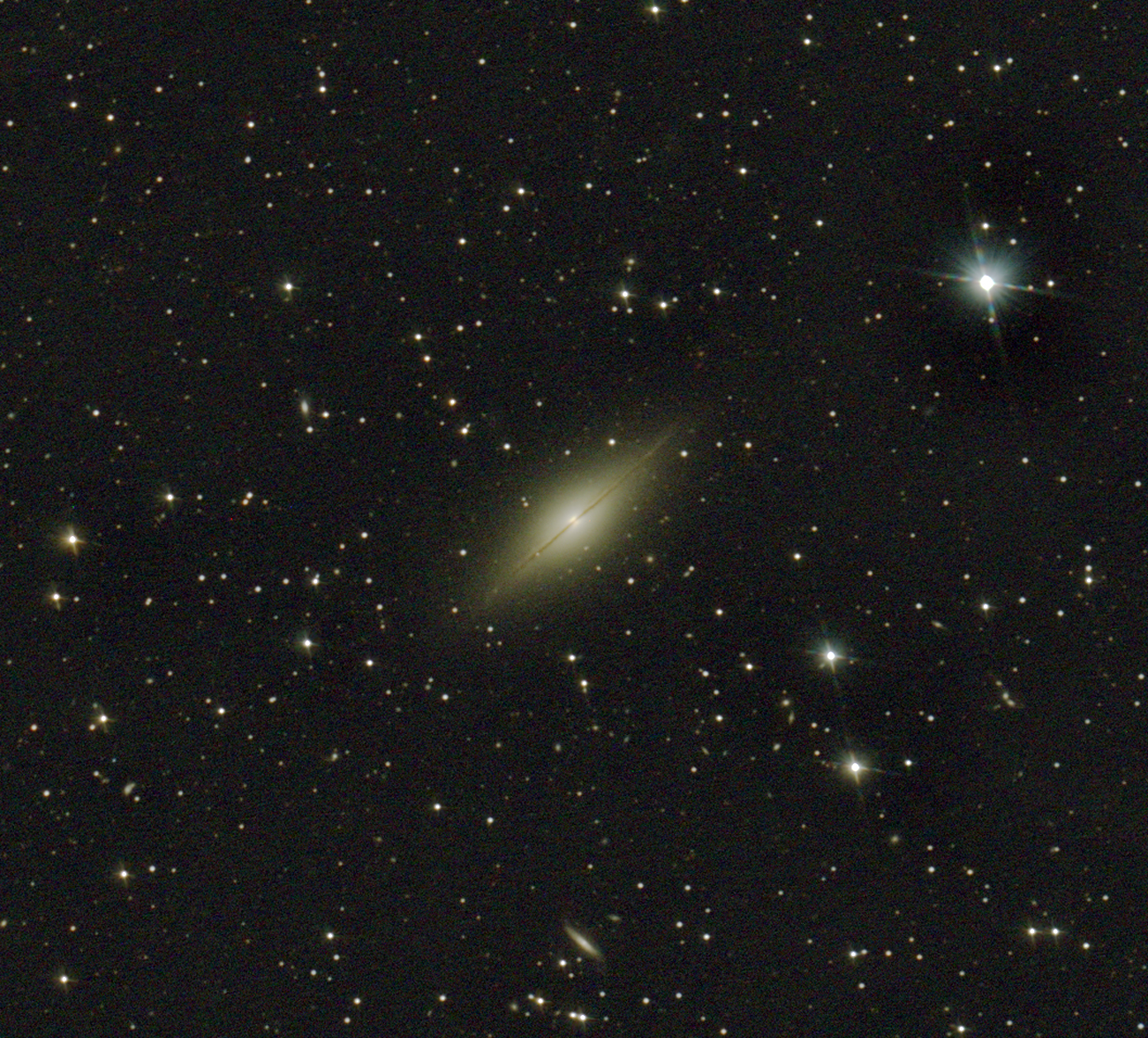


M-108 (NGC-3556): This is an unusual edge-on irregular galaxy with a mottled
texture and several superimposed stars. It is quite large and bright, and forms a
photogenic pair with the much closer M-97, the so-called "Owl" nebula, at the
upper left hand corner of the image. M-97 (NGC-3587) lies within our own galaxy
at a distance of 2,000 light years. M-108, however, is an external galaxy in our
local group, lying about 45 million light years from earth.
NOTE: This image was captured on the evening of April 8, 2019 and is an
integration of ten 360 second sub-exposures through the C-11 at f/2 using Hyper
Star. Guided, captured and combined using Maxim DL 5. Post processed using
Photoshop CS2, levels, curves, Carboni's Astro Tools & Gradient EXterminator.
texture and several superimposed stars. It is quite large and bright, and forms a
photogenic pair with the much closer M-97, the so-called "Owl" nebula, at the
upper left hand corner of the image. M-97 (NGC-3587) lies within our own galaxy
at a distance of 2,000 light years. M-108, however, is an external galaxy in our
local group, lying about 45 million light years from earth.
NOTE: This image was captured on the evening of April 8, 2019 and is an
integration of ten 360 second sub-exposures through the C-11 at f/2 using Hyper
Star. Guided, captured and combined using Maxim DL 5. Post processed using
Photoshop CS2, levels, curves, Carboni's Astro Tools & Gradient EXterminator.


NGC-3521 in Leo: This is a large spiral galaxy in southern Leo. Its morphological
classification is SABbc, meaning it is a spiral with a large nucleus with a trace of a
central bar and patchy, loosely wound outer arms with flocculent structure. Visually
it is 11th magnitude and is 11' X 5' in size. It lies 25 million light years from Earth.
NOTE: This image is an integration of five 6-minute exposures through the C-11 at
f/2 using HyperStar and the ZWO ASI 071MC camera. Guided, captured and
combined using Maxim DL5 Pro. Post processed using PhotoShop CS2.
classification is SABbc, meaning it is a spiral with a large nucleus with a trace of a
central bar and patchy, loosely wound outer arms with flocculent structure. Visually
it is 11th magnitude and is 11' X 5' in size. It lies 25 million light years from Earth.
NOTE: This image is an integration of five 6-minute exposures through the C-11 at
f/2 using HyperStar and the ZWO ASI 071MC camera. Guided, captured and
combined using Maxim DL5 Pro. Post processed using PhotoShop CS2.


