| GALAXY GROUPS (CLICK ON THUMBNAILS TO VIEW FULL SIZED IMAGE) |
The NGC-3190 Galaxy Group (Hickson 44): A group of four various types of galaxies
located in the "Sickle" of Leo between Gamma and Zeta Leonis. The brightest is NGC-3190,
an inclined spiral with a dust lane, located near the center of the photo. Next brightest is the
elliptical galaxy NGC-3193, just above and to the left of a bright star just below NGC-3190.
The other two members are spiral galaxies; NGC-3185 to the right of NGC-3190, and
NGC-3187 just above NGC-3190. Just right of a line between 3187 and 3185 is the faint
galaxy PGC-86788. Left of a line from 3190 up to 3187 is the faint galaxy PGC-280671. At
the upper right edge of the frame is galaxy CGCG-123-33. This group lies at a distance of 73
million light years from earth. Visually, the group is fairly bright, except for NGC-3187. All fit
easily into the field of a wide-angle eyepiece.
NOTE: This image captured on February 17, 2018, and is an integration of six 800 second
exposures through the C-11 at f/2 using the HyperStar 3 imaging system and the
Starlight Express SXVR-H694C camera. Guided, captured and combined using Maxim DL 5,
Post processed in PhotoShop CS2, levels, curves,contrast, Gradient Xterminator, StarShrink.
located in the "Sickle" of Leo between Gamma and Zeta Leonis. The brightest is NGC-3190,
an inclined spiral with a dust lane, located near the center of the photo. Next brightest is the
elliptical galaxy NGC-3193, just above and to the left of a bright star just below NGC-3190.
The other two members are spiral galaxies; NGC-3185 to the right of NGC-3190, and
NGC-3187 just above NGC-3190. Just right of a line between 3187 and 3185 is the faint
galaxy PGC-86788. Left of a line from 3190 up to 3187 is the faint galaxy PGC-280671. At
the upper right edge of the frame is galaxy CGCG-123-33. This group lies at a distance of 73
million light years from earth. Visually, the group is fairly bright, except for NGC-3187. All fit
easily into the field of a wide-angle eyepiece.
NOTE: This image captured on February 17, 2018, and is an integration of six 800 second
exposures through the C-11 at f/2 using the HyperStar 3 imaging system and the
Starlight Express SXVR-H694C camera. Guided, captured and combined using Maxim DL 5,
Post processed in PhotoShop CS2, levels, curves,contrast, Gradient Xterminator, StarShrink.
M-96/M-105 Galaxy Group: This group of galaxies lie about 1/3 of the way from Regulus (A Leonis) to
Denebola (B Leonis). The brightest member is M-96, at the upper LH corner (SE) of the image. About 1
degree to the NNE (at the RH side) of the image, lies M-105 (top) an E-1 elliptical galaxy, NGC-3384
(lower R) an E-7 elliptical, and NGC-3389 (lower L) an Sc Spiral galaxy. This group of galaxies lie at a
distance of about 29 million light years from earth.
NOTE: This image is a composite of ten 360-second exposures taken through the C-11at f/2 using the
HyperStar 3 imaging system and SXVR-H694C 1-shot color CCD imager. Guided, captured and combined
using Maxim DL 5 Pro. Post-processed in PhotoshopCS, levels, curves, color balance and
Gradient X-Terminator and StarShrink. Image taken on March 2, 2017.
Denebola (B Leonis). The brightest member is M-96, at the upper LH corner (SE) of the image. About 1
degree to the NNE (at the RH side) of the image, lies M-105 (top) an E-1 elliptical galaxy, NGC-3384
(lower R) an E-7 elliptical, and NGC-3389 (lower L) an Sc Spiral galaxy. This group of galaxies lie at a
distance of about 29 million light years from earth.
NOTE: This image is a composite of ten 360-second exposures taken through the C-11at f/2 using the
HyperStar 3 imaging system and SXVR-H694C 1-shot color CCD imager. Guided, captured and combined
using Maxim DL 5 Pro. Post-processed in PhotoshopCS, levels, curves, color balance and
Gradient X-Terminator and StarShrink. Image taken on March 2, 2017.
 |
NGC-4038/4039: A very interesting interacting pair of galaxies in the constellation of Corvus the Crow. In
this picture, NGC-4038 is the brighter galaxy to the right (north). On long-exposure photos and Hubble
Space Telescope images, much detail is seen, including two long filaments extending to the NE and SE of
the main bodies of the two galaxies. The left image has started to capture one of the filaments, which
appears as a faint wedge of nebulosity extending to the upper left of the left-hand galaxy, NGC-4039.
Also visible are many reddish areas, which are large regions of hydrogen gas where star formation has
been triggered by the tidal effect of the collision of the two galaxies. This pair of galaxies lies over 90
million light years from earth. Visually, this contact pair resembles a faint ghostly "Pac-Man". NOTE: The
image on the left is an integration of twenty-five 100-second exposures taken through the 80mm f/7.5
APO Refractor. The image on the right was captured through the C-11 @ f/2 using HyperStar, and is an
integration of ten 180 second exposures. The left image was captured in Maxim DL, the right image was
captured in Nebulosity. Both were post-processed using Photoshop CS, Astro Tools and Noiseware.
this picture, NGC-4038 is the brighter galaxy to the right (north). On long-exposure photos and Hubble
Space Telescope images, much detail is seen, including two long filaments extending to the NE and SE of
the main bodies of the two galaxies. The left image has started to capture one of the filaments, which
appears as a faint wedge of nebulosity extending to the upper left of the left-hand galaxy, NGC-4039.
Also visible are many reddish areas, which are large regions of hydrogen gas where star formation has
been triggered by the tidal effect of the collision of the two galaxies. This pair of galaxies lies over 90
million light years from earth. Visually, this contact pair resembles a faint ghostly "Pac-Man". NOTE: The
image on the left is an integration of twenty-five 100-second exposures taken through the 80mm f/7.5
APO Refractor. The image on the right was captured through the C-11 @ f/2 using HyperStar, and is an
integration of ten 180 second exposures. The left image was captured in Maxim DL, the right image was
captured in Nebulosity. Both were post-processed using Photoshop CS, Astro Tools and Noiseware.
The Virgo Galaxy Cluster: This image is centered just to the east of the giant elliptical
galaxy M-86, and shows the center of the huge cluster of galaxies located in western Virgo,
approximately halfway between the star Denebola (B Leonis) and Epsilon Virginis. This
image shows many galaxies besides the two dominant members, M-86 and M-84. In all, over
35 galaxies are identified in this annotated image. But several other non-identified galaxies
can also be seen, some as faint as 18th magnitude. This group is also sometimes called
"Markarian's Chain", after the astronomer who identified the fact that they are all
gravitationally interacting with each other. This group of galaxies lies approximately 53 million
light years from Earth.
NOTE: This image was captured on the evening of May 17, 2018, and is an integration of
ten 360-second sub-exposures, for a total exposure time of 60 minutes through the Celestron
11 at f/2 using the HyperStar imaging system and the ZWO-ASI-071-MC-Cool 1-shot color
CMOS camera. Captured and combined using Maxim DL 5 Pro. Post processed in Photoshop
CS2, using levels, curves, color saturation, Gradient X-Terminator and StarShrink.
galaxy M-86, and shows the center of the huge cluster of galaxies located in western Virgo,
approximately halfway between the star Denebola (B Leonis) and Epsilon Virginis. This
image shows many galaxies besides the two dominant members, M-86 and M-84. In all, over
35 galaxies are identified in this annotated image. But several other non-identified galaxies
can also be seen, some as faint as 18th magnitude. This group is also sometimes called
"Markarian's Chain", after the astronomer who identified the fact that they are all
gravitationally interacting with each other. This group of galaxies lies approximately 53 million
light years from Earth.
NOTE: This image was captured on the evening of May 17, 2018, and is an integration of
ten 360-second sub-exposures, for a total exposure time of 60 minutes through the Celestron
11 at f/2 using the HyperStar imaging system and the ZWO-ASI-071-MC-Cool 1-shot color
CMOS camera. Captured and combined using Maxim DL 5 Pro. Post processed in Photoshop
CS2, using levels, curves, color saturation, Gradient X-Terminator and StarShrink.
M-61 Galaxy Group: This image is centered on the face-on spiral galaxy M-61 (NGC-4303).
M-61 lies at the southern edge of the great Virgo Galaxy Cluster, about 2 degrees north and
just slightly east of the 5th magnitude star 16 Virginis. This image clearly shows M-61's two
companion galaxies, NGC-4303A (left center of photo) and NGC-4292 (upper right corner).
M-61 is a beautiful 3-armed spiral galaxy of 10th magnitude, one of the larger galaxies in the
Virgo cluster. The photo shows its bright compact nucleus and the unusual crooked spiral
arms which contain many knots and condensations of stars. M-61 lies at a distance of about
30 million light years. At this distance, its 6 arcminute diameter corresponds to an actual
diameter of over 60,000 light years.
NOTE: This image is an integration of twenty 70-second exposures through the 80mm f/7.5
ED Apochromatic refractor. The images were captured and processed using Nebulosity, with
further post-processing in PhotoshopCS and NoiseWare.
M-61 lies at the southern edge of the great Virgo Galaxy Cluster, about 2 degrees north and
just slightly east of the 5th magnitude star 16 Virginis. This image clearly shows M-61's two
companion galaxies, NGC-4303A (left center of photo) and NGC-4292 (upper right corner).
M-61 is a beautiful 3-armed spiral galaxy of 10th magnitude, one of the larger galaxies in the
Virgo cluster. The photo shows its bright compact nucleus and the unusual crooked spiral
arms which contain many knots and condensations of stars. M-61 lies at a distance of about
30 million light years. At this distance, its 6 arcminute diameter corresponds to an actual
diameter of over 60,000 light years.
NOTE: This image is an integration of twenty 70-second exposures through the 80mm f/7.5
ED Apochromatic refractor. The images were captured and processed using Nebulosity, with
further post-processing in PhotoshopCS and NoiseWare.
GALAXY TRIO IN LEO: Visually, this is one of the nicest groups of galaxies in the northern sky. The trio is
nicely framed in a low-power wide-field eyepiece in most moderate sized amateur telescopes. M-66, to the
upper left,is the brightest member, at 9.7 magnitude with a bright core. M-65, to the left, is about the same
magnitude, but does not have as bright a core. Visually, these two galaxies are 21 arc minutes apart. 36
arc minutes north (right) ofthis pair lies the fainter edge-on galaxy, NGC-3628, which is much larger,
measuring 12 arcminutes in length, but is much fainter. Both M-65 and M-66 are class Sb spiral galaxies,
though M-66 is much different in appearance due to its assymetric spiral arms and elongated core area.
M-65 is a more symmetric oval with a smoother texture. NGC-3628 has a vague envelope bisected with a
prominent dust lane which is easily seen in amateur telescopes. This trio of galaxies is gravitationally
connected, and lie at a distance of approximately 30 million light years from earth.
NOTE: The LH image was taken on May 4, 2014, and is an integration of eleven 300 second exposures
through the Celestron 11 at f/2 using the HyperStar system and the Starlight Express SXVR-H694C color
CCD imager. Guided, captured and combined using Maxim DL 5 pro. Post processed using PhotoShop CS.
The RH image was taken on June 4, 2016, and is an integration of seven 300 second exposures with the
same instrument. This image shows the Supernova 2016cok indicated by the tick marks.
nicely framed in a low-power wide-field eyepiece in most moderate sized amateur telescopes. M-66, to the
upper left,is the brightest member, at 9.7 magnitude with a bright core. M-65, to the left, is about the same
magnitude, but does not have as bright a core. Visually, these two galaxies are 21 arc minutes apart. 36
arc minutes north (right) ofthis pair lies the fainter edge-on galaxy, NGC-3628, which is much larger,
measuring 12 arcminutes in length, but is much fainter. Both M-65 and M-66 are class Sb spiral galaxies,
though M-66 is much different in appearance due to its assymetric spiral arms and elongated core area.
M-65 is a more symmetric oval with a smoother texture. NGC-3628 has a vague envelope bisected with a
prominent dust lane which is easily seen in amateur telescopes. This trio of galaxies is gravitationally
connected, and lie at a distance of approximately 30 million light years from earth.
NOTE: The LH image was taken on May 4, 2014, and is an integration of eleven 300 second exposures
through the Celestron 11 at f/2 using the HyperStar system and the Starlight Express SXVR-H694C color
CCD imager. Guided, captured and combined using Maxim DL 5 pro. Post processed using PhotoShop CS.
The RH image was taken on June 4, 2016, and is an integration of seven 300 second exposures with the
same instrument. This image shows the Supernova 2016cok indicated by the tick marks.

Stephan's Quintet: A very compact grouping of five galaxies located in the constellation of Pegasus about 1/2
degree south-southwest of the bright galaxy NGC-7331. Of the five galaxies, only the four faintest are actually
gravitationally involved. The brightest member, NGC-7320, is actually a foreground object, at a distance of about 40
million light years. The other four are far more distant, at a distance of over 230 million light years.
NOTE: The image on the left was captured on August 23, 2014 and is an integration of ten 360-second exposures
through the C-11 at f/2 using HyperStar and the SXVR-H694C camera. The image on the right is courtesy of
NOAO at Kitt Peak National Observatory, and is included to show the identification of the five galaxies and to
better show the gravitational distortions and streamers caused by the interaction of the four involved galaxies.
degree south-southwest of the bright galaxy NGC-7331. Of the five galaxies, only the four faintest are actually
gravitationally involved. The brightest member, NGC-7320, is actually a foreground object, at a distance of about 40
million light years. The other four are far more distant, at a distance of over 230 million light years.
NOTE: The image on the left was captured on August 23, 2014 and is an integration of ten 360-second exposures
through the C-11 at f/2 using HyperStar and the SXVR-H694C camera. The image on the right is courtesy of
NOAO at Kitt Peak National Observatory, and is included to show the identification of the five galaxies and to
better show the gravitational distortions and streamers caused by the interaction of the four involved galaxies.
The Pegasus 1 Galaxy Cluster: Located about 5 degrees SW of Markab (A Pegasi) this is a dense cluster of
galaxies lying at a distance of over 200 million light years from earth. Like the nearer Virgo cluster, it is centered on a
pair of giant elliptical galaxies, NGC- 7619 to the west (right) and NGC-7626 to the east (left). Both of these galaxies
shine at 11th magnitude. Just to the SW of NGC-7619 lies 13.8 mag. NGC-7617. Further SW is the brighter oval
galaxy NGC 7611.To the ESE of NGC-7626 lies the 16.5 mag. edge-on galaxy UGC-12535. Just east of its south tip is
16th mag. MAC-2321-0810. Due east (left) of this pair is 13.9 mag. NGC-7631. Due north of 7626 halfway to the edge
of the frame lie a trio of galaxies, 13.9 mag. NGC-7623 in the middle, with 15.7 mag. NGC-7621 to the SW and 16th
mag. MAC-2320-0823 to the ESE. Just SW of NGC-7621 lies the very small 16.5 mag. MAC-2320-0820. To the right of
7619 is a pair of stars on a SW/NE line. Just NE of this pair lies 16th mag. MAC-2319-0819. Due south of the southern
star is 14th mag. UGC-12510. Due east of it, lies the small 17th mag. MAC-2319-0816. North of these galaxies, in the
upper right-hand corner of the frame is NGC 7615, and a smaller galaxy to the east (left). In all, there are 16 galaxies
in this image. This image acquired on Sept. 22, 2014, and is an integration of eighteen 6-minute exposures through
the C-11 at f/2 for a total exposure duration of 1 hour 48 min. Captured and combined using Maxim DL Pro v. 5.2.
Post-processed using Photoshop CS2, levels, curves, color balance, Astro-Tools and Gradient XTerminator.
galaxies lying at a distance of over 200 million light years from earth. Like the nearer Virgo cluster, it is centered on a
pair of giant elliptical galaxies, NGC- 7619 to the west (right) and NGC-7626 to the east (left). Both of these galaxies
shine at 11th magnitude. Just to the SW of NGC-7619 lies 13.8 mag. NGC-7617. Further SW is the brighter oval
galaxy NGC 7611.To the ESE of NGC-7626 lies the 16.5 mag. edge-on galaxy UGC-12535. Just east of its south tip is
16th mag. MAC-2321-0810. Due east (left) of this pair is 13.9 mag. NGC-7631. Due north of 7626 halfway to the edge
of the frame lie a trio of galaxies, 13.9 mag. NGC-7623 in the middle, with 15.7 mag. NGC-7621 to the SW and 16th
mag. MAC-2320-0823 to the ESE. Just SW of NGC-7621 lies the very small 16.5 mag. MAC-2320-0820. To the right of
7619 is a pair of stars on a SW/NE line. Just NE of this pair lies 16th mag. MAC-2319-0819. Due south of the southern
star is 14th mag. UGC-12510. Due east of it, lies the small 17th mag. MAC-2319-0816. North of these galaxies, in the
upper right-hand corner of the frame is NGC 7615, and a smaller galaxy to the east (left). In all, there are 16 galaxies
in this image. This image acquired on Sept. 22, 2014, and is an integration of eighteen 6-minute exposures through
the C-11 at f/2 for a total exposure duration of 1 hour 48 min. Captured and combined using Maxim DL Pro v. 5.2.
Post-processed using Photoshop CS2, levels, curves, color balance, Astro-Tools and Gradient XTerminator.

The NGC-183 Galaxy Group: Located in western Andromeda, this group of galaxies lie at a
distance of approximately 200 million light years from earth. This group is also known as the
Abell 71 Galaxy Cluster. The brightest member, NGC-183, is just below and left (west) of the
center of the image. The edge-on galaxy NGC-181 lies just SW, and NGC-184 lies a bit further
due south. This group is just 12 arcminutes north of the star 30 Andromedae. The images of
10 other faint galaxies also appear in this frame. This image was captured on the evening of
11/4/2010, and is a composite of fifteen 60-second exposures through the 11" Celestron at f/2
using the HyperStar system. Captured and processed in Nebulosity v.2.2.8, with
post-processing in Photoshop CS.
distance of approximately 200 million light years from earth. This group is also known as the
Abell 71 Galaxy Cluster. The brightest member, NGC-183, is just below and left (west) of the
center of the image. The edge-on galaxy NGC-181 lies just SW, and NGC-184 lies a bit further
due south. This group is just 12 arcminutes north of the star 30 Andromedae. The images of
10 other faint galaxies also appear in this frame. This image was captured on the evening of
11/4/2010, and is a composite of fifteen 60-second exposures through the 11" Celestron at f/2
using the HyperStar system. Captured and processed in Nebulosity v.2.2.8, with
post-processing in Photoshop CS.


NGC-3718 and Hickson 56: This galaxy group lies just southeast of the star Phact (Gamma Ursa
Majoris) at the southwest corner of the bowl of the Big Dipper. NGC-3718 is severely distorted due to
interaction with its neighbor NGC-3729 to the west (upper left). About 8 arcminutes south of 3718 lies the
distant galaxy group Hickson 56, consisting of 5 tiny galaxies in a space of just 3 arcminutes. From left to
right in this image, they are PGC35631 (16.1 mag) PGC35620 (14.9 mag) PGC35618 (15.8 mag)
PGC35615 (16.8 mag) and PGC35609 (16.4 mag). These galaxies are 9 times more distant than
NGC-3718. NOTE: This image was captured on the evening of May 21, 2017, and is a composite of 16
360-second sub-exposures through the C-11 at f/2 using the HyperStar 3 imaging system and the
Starlight Express SXVR-H694C 1-shot color CCD Camera. Guided,captured and combined in Maxim DL 5
Pro and post-processed using Photoshop CS, levels, curves, Gradient XTerminator and StarShrink.
Majoris) at the southwest corner of the bowl of the Big Dipper. NGC-3718 is severely distorted due to
interaction with its neighbor NGC-3729 to the west (upper left). About 8 arcminutes south of 3718 lies the
distant galaxy group Hickson 56, consisting of 5 tiny galaxies in a space of just 3 arcminutes. From left to
right in this image, they are PGC35631 (16.1 mag) PGC35620 (14.9 mag) PGC35618 (15.8 mag)
PGC35615 (16.8 mag) and PGC35609 (16.4 mag). These galaxies are 9 times more distant than
NGC-3718. NOTE: This image was captured on the evening of May 21, 2017, and is a composite of 16
360-second sub-exposures through the C-11 at f/2 using the HyperStar 3 imaging system and the
Starlight Express SXVR-H694C 1-shot color CCD Camera. Guided,captured and combined in Maxim DL 5
Pro and post-processed using Photoshop CS, levels, curves, Gradient XTerminator and StarShrink.

The NGC-5982 Group: Located in the constellation of Draco, this is a very pretty and interesting trio of
galaxies, due to the contrasts in morphology: A spiral, an elliptical and an edge-on galaxy side by side!!
These differences are very apparent even visually through moderate sized telescopes!
NOTE: Left image captured on August 10, 2012, and is an integration of fifteen 100 second exposures
through the 11-inch Celestron at f/2 using HyperStar and the Starlight Express SXVR H649C CCD
camera. Captured and combined using Maxim DL 5 Pro. Post-processing in Photoshop CS, levels, curves,
Astro-tools and GradientXTerminator. Image on RIGHT captured on 5/30/2020, and is an integration of 6
240 sec. exposures through the same instrument using the ZWO ASI071 MC CMOS camera. Guided,
captured & combined in Maxim DL5. Post processed in PhotoShop CS2.
galaxies, due to the contrasts in morphology: A spiral, an elliptical and an edge-on galaxy side by side!!
These differences are very apparent even visually through moderate sized telescopes!
NOTE: Left image captured on August 10, 2012, and is an integration of fifteen 100 second exposures
through the 11-inch Celestron at f/2 using HyperStar and the Starlight Express SXVR H649C CCD
camera. Captured and combined using Maxim DL 5 Pro. Post-processing in Photoshop CS, levels, curves,
Astro-tools and GradientXTerminator. Image on RIGHT captured on 5/30/2020, and is an integration of 6
240 sec. exposures through the same instrument using the ZWO ASI071 MC CMOS camera. Guided,
captured & combined in Maxim DL5. Post processed in PhotoShop CS2.

The NGC-5846 Group: A group of galaxies in Eastern Virgo, lying at a distance of 85 million light
years from Earth. The center of the group is dominated by the giant elliptical galaxy NGC-5846. Its
nearby companion, NGC-5850 (just to the upper left) is a classic face-on barred spiral galaxy. Just to
the lower right is the smaller elliptical NGC-5845 and further down and to the right is brighter NGC-5839.
At the right edge of the image is the edge-on spiral galaxy NGC-5813. Also visible, just inside the halo
of 5846, is the small galaxy PGC-53930.
NOTE: This image was captured on the evening of July 14, 2012, and is an integration of fifteen 100
second exposures through the 11-inch Celestron using HyperStar and the SXVR-H694C color imager.
Captured and combined using Maxim DL 5 Pro. Post-processed in Photoshop CS.
years from Earth. The center of the group is dominated by the giant elliptical galaxy NGC-5846. Its
nearby companion, NGC-5850 (just to the upper left) is a classic face-on barred spiral galaxy. Just to
the lower right is the smaller elliptical NGC-5845 and further down and to the right is brighter NGC-5839.
At the right edge of the image is the edge-on spiral galaxy NGC-5813. Also visible, just inside the halo
of 5846, is the small galaxy PGC-53930.
NOTE: This image was captured on the evening of July 14, 2012, and is an integration of fifteen 100
second exposures through the 11-inch Celestron using HyperStar and the SXVR-H694C color imager.
Captured and combined using Maxim DL 5 Pro. Post-processed in Photoshop CS.
The NGC-5350 Group: Also known as Hickson 68. A compact group of galaxies located in Canes
Venatici, next to the 6th magnitude star HD-121197 (at the upper center of the image). The two brightest
galaxies in the group are the interacting elliptical galaxies NGCs 5353 & 5354, just south of the star.
These galaxies are11th magnitude. NGC-5350 is the face-on barred spiral galaxy just to the right of the
star. It is 11.3 magnitude, but is visually fainter because of its smaller core. The faintest galaxy in the
group is the small elliptical galaxy NGC-5355 which forms a triangle with the other three. South of the
5353/4 duo is NGC-5358.The edge-on galaxy at the lower right is 14.7 mag. UGC-8841. This group lies
approximately 100 million light years from Earth.
NOTE: This image captured on 7/7/18, and is an integration of 14 six-minute sub-exposures through
the C-11 at f/2 using HyperStar and the Starlight Express SXVR-694C CCD imager. Guided, captured and
combined using Maxim DL5. Post-processed in PhotoShop CS2, using levels, curves, Astro Tools,
Gradient XTerminator and StarShrink.
Venatici, next to the 6th magnitude star HD-121197 (at the upper center of the image). The two brightest
galaxies in the group are the interacting elliptical galaxies NGCs 5353 & 5354, just south of the star.
These galaxies are11th magnitude. NGC-5350 is the face-on barred spiral galaxy just to the right of the
star. It is 11.3 magnitude, but is visually fainter because of its smaller core. The faintest galaxy in the
group is the small elliptical galaxy NGC-5355 which forms a triangle with the other three. South of the
5353/4 duo is NGC-5358.The edge-on galaxy at the lower right is 14.7 mag. UGC-8841. This group lies
approximately 100 million light years from Earth.
NOTE: This image captured on 7/7/18, and is an integration of 14 six-minute sub-exposures through
the C-11 at f/2 using HyperStar and the Starlight Express SXVR-694C CCD imager. Guided, captured and
combined using Maxim DL5. Post-processed in PhotoShop CS2, using levels, curves, Astro Tools,
Gradient XTerminator and StarShrink.

The NGC-4169 Group: Also known as Hickson 61, and commonly called "The Box". This is a very
compact group of small galaxies located in western Virgo. The brightest member of the group is the
elliptical galaxy NGC-4169, which forms the lower right hand corner of the "Box". The next brightest
member is NGC-4175, at the upper left hand corner. Next brightest is NGC-4174, the small edge-on
galaxy at the upper right hand corner. The faintest galaxy is the large, vague edge-on spiral NGC-4173,
at the lower left hand corner. All four can be observed visually with a 10-inch scope under dark skies.
NOTE: This image captured on the evening of 5/21/2012, and is an integration of ten 90-second sub
exposures through the C-11 at f/2 using HyperStar and the Orion Starshoot CCD imager. Captured and
combined using Maxim DL 5 Pro. Post-processed in Photoshop CS using levels, curves, Astro-tools and
Gradient X-terminator. Noise filtered and converted to JPEG format using NoiseWare.
compact group of small galaxies located in western Virgo. The brightest member of the group is the
elliptical galaxy NGC-4169, which forms the lower right hand corner of the "Box". The next brightest
member is NGC-4175, at the upper left hand corner. Next brightest is NGC-4174, the small edge-on
galaxy at the upper right hand corner. The faintest galaxy is the large, vague edge-on spiral NGC-4173,
at the lower left hand corner. All four can be observed visually with a 10-inch scope under dark skies.
NOTE: This image captured on the evening of 5/21/2012, and is an integration of ten 90-second sub
exposures through the C-11 at f/2 using HyperStar and the Orion Starshoot CCD imager. Captured and
combined using Maxim DL 5 Pro. Post-processed in Photoshop CS using levels, curves, Astro-tools and
Gradient X-terminator. Noise filtered and converted to JPEG format using NoiseWare.
The NGC-708 Galaxy Group: A dense cluster of galaxies in Andromeda, also known as Abell Galaxy
Cluster 262. This frame is centered on 13.6 mag. NGC-708, a massive elliptical galaxy which is similar to
M-87 in the Virgo Cluster. NGC-708 has an active galactic nucleus which is believed to harbor a super
massive black hole. Just below and to the right of 708 is 14th mag. NGC-705, an edge-on spiral with a
central bulge. Just below 705 is NGC-704. Above and to the right of 708 is the 14th mag. lenticular
galaxy, NGC-703. These 4 galaxies form a triangular group at the center of this cluster of galaxies. Just
below and to the left of 708 is the face-on spiral galaxy NGC-710. At the upper right edge of the image
are a trio of galaxies, UGCs 1344, 1347 & 1350. At the right edge of the image are two bright elliptical
galaxies, UGC-1308 and NGC-687. This image is approximately 1 degree square and contains images
of over 37 galaxies!
NOTE: This image was captured on 10/18/2012 and is an integration of eight 5-minute exposures through
the 11-inch Celestron at f/2 using HyperStar and the SXVR-H649C 6 megapixel color CCD imager.
Captured and combined using Maxim DL 5 Pro. Post-processed using Photoshop CS, levels, curves,
Astro-Tools and Gradient X-terminator. Filtered and converted to JPEG format using NoiseWare.
Cluster 262. This frame is centered on 13.6 mag. NGC-708, a massive elliptical galaxy which is similar to
M-87 in the Virgo Cluster. NGC-708 has an active galactic nucleus which is believed to harbor a super
massive black hole. Just below and to the right of 708 is 14th mag. NGC-705, an edge-on spiral with a
central bulge. Just below 705 is NGC-704. Above and to the right of 708 is the 14th mag. lenticular
galaxy, NGC-703. These 4 galaxies form a triangular group at the center of this cluster of galaxies. Just
below and to the left of 708 is the face-on spiral galaxy NGC-710. At the upper right edge of the image
are a trio of galaxies, UGCs 1344, 1347 & 1350. At the right edge of the image are two bright elliptical
galaxies, UGC-1308 and NGC-687. This image is approximately 1 degree square and contains images
of over 37 galaxies!
NOTE: This image was captured on 10/18/2012 and is an integration of eight 5-minute exposures through
the 11-inch Celestron at f/2 using HyperStar and the SXVR-H649C 6 megapixel color CCD imager.
Captured and combined using Maxim DL 5 Pro. Post-processed using Photoshop CS, levels, curves,
Astro-Tools and Gradient X-terminator. Filtered and converted to JPEG format using NoiseWare.

The NGC-3091 Group: Also known as Hickson 42. A compact group of galaxies in Hydra, dominated
by NGC-3091, an 11th magnitude elliptical galaxy which appears just below center in this image. Just
above and to the left of 3091 is NGC-3096(Hickson 42b), a 13th mag. type SBO galaxy. Straight below
NGC-3096 is the much smaller and dimmer PGC-852084. The small, bright round galaxy just right of
NGC-3091 is PGC-28922(Hickson 42c). Directly below and just to the left of 3091 is another faint PGC
galaxy, 28926 (Hickson 42d). Another galaxy, edge-on NGC-3085, lies near the lower right hand corner
of the image. In all, there are 10 galaxies in this image.
NOTE: Image captured on the evening of 3/14/2013 and is an integration of five 4-minute exposures
through the C-11 at f/2 using HyperStar and the SXVR-H694C imager. Captured and combined using
Maxim DL 5. Post processed in Photoshop CS, levels, curves, color balance, Gradient X-terminator and
NoiseWare.
by NGC-3091, an 11th magnitude elliptical galaxy which appears just below center in this image. Just
above and to the left of 3091 is NGC-3096(Hickson 42b), a 13th mag. type SBO galaxy. Straight below
NGC-3096 is the much smaller and dimmer PGC-852084. The small, bright round galaxy just right of
NGC-3091 is PGC-28922(Hickson 42c). Directly below and just to the left of 3091 is another faint PGC
galaxy, 28926 (Hickson 42d). Another galaxy, edge-on NGC-3085, lies near the lower right hand corner
of the image. In all, there are 10 galaxies in this image.
NOTE: Image captured on the evening of 3/14/2013 and is an integration of five 4-minute exposures
through the C-11 at f/2 using HyperStar and the SXVR-H694C imager. Captured and combined using
Maxim DL 5. Post processed in Photoshop CS, levels, curves, color balance, Gradient X-terminator and
NoiseWare.


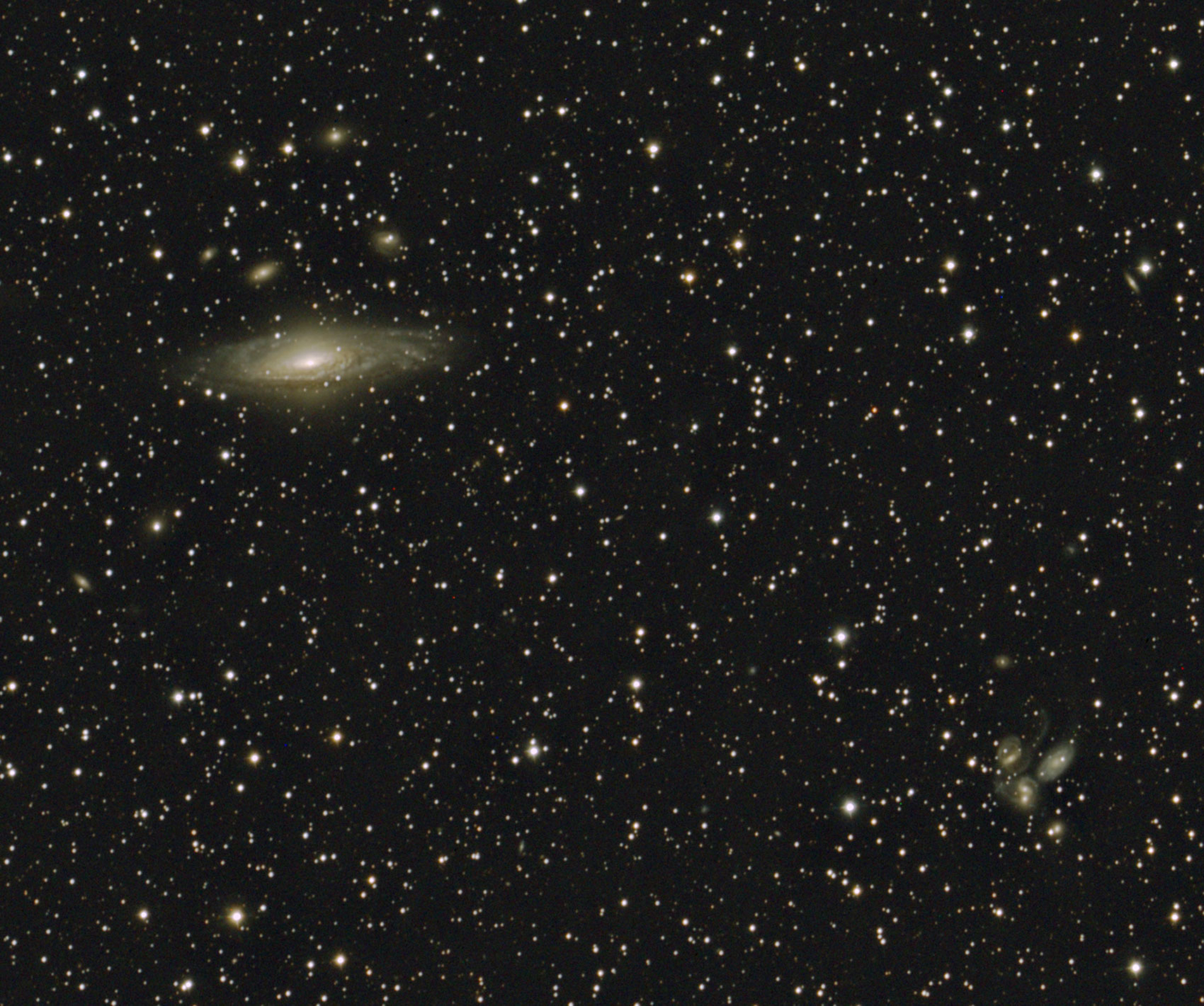
The NGC-7331 Group: Sometimes referred to as "The Deer Lick Group". This group is dominated by
the large, bright spiral galaxy NGC-7331, a type SA galaxy which lies about 43 million light years from
Earth. There are four smaller galaxies to the north of 7331. In this image, starting at the left, there is
7336, a small, oval 17th magnitude blob. To its right is NGC-7335, at 14th magnitude, the brightest of
the 4 satellite galaxies. To its upper right is NGC-7340, 14.7 magnitude, and below at to its right is
NGC-7337, a 14.7 magnitude face-on spiral. Just below and to the left of 7331's left spiral arm is small,
round 17th magnitude PGC-69291, and below and to its left is 15.7 magnitude CGCG-514-66. In the
lower right corner of this image is the famous Stephan's Quintet group of galaxies formed by NGCs
7317, 7318A and B, 7319 and 7320. A close-up of Stephan's Quintet appears above, in the left-hand
column of images.
NOTE: This image acquired on the evening of August 23, 2014, and is an integration of ten 360-second
exposures through the Celestron C-11 at f/2 using the HyperStar system and the Starlight Express
SXVR-H694C 1-shot color imager. The images were captured and combined using Maxim DL Pro v 5.2.
Post-processed in PhotoshopCS, levels, curves, colorbalance, Astro-Tools and Gradient XTerminator.
Copyright Ron Abbott 2014.
the large, bright spiral galaxy NGC-7331, a type SA galaxy which lies about 43 million light years from
Earth. There are four smaller galaxies to the north of 7331. In this image, starting at the left, there is
7336, a small, oval 17th magnitude blob. To its right is NGC-7335, at 14th magnitude, the brightest of
the 4 satellite galaxies. To its upper right is NGC-7340, 14.7 magnitude, and below at to its right is
NGC-7337, a 14.7 magnitude face-on spiral. Just below and to the left of 7331's left spiral arm is small,
round 17th magnitude PGC-69291, and below and to its left is 15.7 magnitude CGCG-514-66. In the
lower right corner of this image is the famous Stephan's Quintet group of galaxies formed by NGCs
7317, 7318A and B, 7319 and 7320. A close-up of Stephan's Quintet appears above, in the left-hand
column of images.
NOTE: This image acquired on the evening of August 23, 2014, and is an integration of ten 360-second
exposures through the Celestron C-11 at f/2 using the HyperStar system and the Starlight Express
SXVR-H694C 1-shot color imager. The images were captured and combined using Maxim DL Pro v 5.2.
Post-processed in PhotoshopCS, levels, curves, colorbalance, Astro-Tools and Gradient XTerminator.
Copyright Ron Abbott 2014.
THE NGC-3227 Group: NGC-3227 is a type SBa spiral galaxy that is interacting with NGC-3226, a
dwarf elliptical galaxy just to the northwest. This pair of galaxies is listed as Arp 94 in Halton Arp's catalog
of peculiar galaxies. This pair lies less than 1 degree east of the well known double star
Gamma Leonis (Algeiba).
NOTE: This image was captured on the evening of April 20th, 2020, and is an integration of eight six
minute exposures through the 11-inch Celestron at f/2 using HyperStar and the ZWO ASI 071MC camera.
Guided, captured and combined using Maxim DL5 Pro. Post processed using PhotoShop CS2.
dwarf elliptical galaxy just to the northwest. This pair of galaxies is listed as Arp 94 in Halton Arp's catalog
of peculiar galaxies. This pair lies less than 1 degree east of the well known double star
Gamma Leonis (Algeiba).
NOTE: This image was captured on the evening of April 20th, 2020, and is an integration of eight six
minute exposures through the 11-inch Celestron at f/2 using HyperStar and the ZWO ASI 071MC camera.
Guided, captured and combined using Maxim DL5 Pro. Post processed using PhotoShop CS2.
The Fornax Galaxy Cluster: A group of over 15 galaxies located on the Fornax/Eridanus
border. This cluster is anchored by the two giant elliptical galaxies NGC-1399 and NGC-1404.
This cluster lies at a distance of 62 million light years from earth. Note: Image taken on Nov.
4, 2016 and is a 1 hour exposure through the C-11 at f/2 using the SXVR-H694C color imager.
Guided, captured and combined in Maxim DL 5. Post-processed in PhotoShop CS2.
border. This cluster is anchored by the two giant elliptical galaxies NGC-1399 and NGC-1404.
This cluster lies at a distance of 62 million light years from earth. Note: Image taken on Nov.
4, 2016 and is a 1 hour exposure through the C-11 at f/2 using the SXVR-H694C color imager.
Guided, captured and combined in Maxim DL 5. Post-processed in PhotoShop CS2.


NGC-7248 (left) and NGC-7250: A pair of small, 13th magnitude spiral galaxies located in the
summer constellation of Lacerta, the Lizard. These two objects are unimpressive visually, appearing
as small, oval blobs of even surface brightness. Both have an apparent size of under 2 arc minutes.
This image is significant only due to the fact that it captures the Type II Supernova 2013dy in galaxy
NGC-7250 (to the right). This is a 1-hour exposure taken on August 10th, 2013 through the C-11 at
f/2 using HyperStar and the SXVR-H694C color CCD imager. Guided, captured and combined using
Maxim DL5. Post processed in PhotoShop CS2.
summer constellation of Lacerta, the Lizard. These two objects are unimpressive visually, appearing
as small, oval blobs of even surface brightness. Both have an apparent size of under 2 arc minutes.
This image is significant only due to the fact that it captures the Type II Supernova 2013dy in galaxy
NGC-7250 (to the right). This is a 1-hour exposure taken on August 10th, 2013 through the C-11 at
f/2 using HyperStar and the SXVR-H694C color CCD imager. Guided, captured and combined using
Maxim DL5. Post processed in PhotoShop CS2.


THE NGC-5965 GROUP: This is a group of 4 galaxies in the constellation of Draco the dragon,
anchored by the 12.6 magnitude edge-on spiral galaxy NGC-5965, located upper right center. This
galaxy measures approximately 4.5 by .75 arc minutes in size. The next brightest galaxy is the
elliptical galaxy NGC-5963, just south of 5965. This galaxy is 13.1 magnitude. The other two galaxies,
one spiral and the other an elliptical are much fainter, at 14.7 and 15.1 respectively.
NOTE: This image, obtained on July 23, 2019, is an integration of ten 2-minute exposures through
the C-11 at f/2 using HyperStar and the SXVR-H694C CCD imager.
anchored by the 12.6 magnitude edge-on spiral galaxy NGC-5965, located upper right center. This
galaxy measures approximately 4.5 by .75 arc minutes in size. The next brightest galaxy is the
elliptical galaxy NGC-5963, just south of 5965. This galaxy is 13.1 magnitude. The other two galaxies,
one spiral and the other an elliptical are much fainter, at 14.7 and 15.1 respectively.
NOTE: This image, obtained on July 23, 2019, is an integration of ten 2-minute exposures through
the C-11 at f/2 using HyperStar and the SXVR-H694C CCD imager.


NGC-4216 GROUP IN VIRGO: This image is centered on the fine edge-on spiral galaxy NGC-4216.
This is an 11th magnitude intermediate galaxy located not far from the center of the Virgo Galaxy
Cluster. It is roughly 55 million light years from Earth. Its apparent size is 8.1' X 1.8'. Its actual size is
over 100,000 light years in diameter.
NOTE: This image is an integration of six 6-minute exposures through the C-11 at f/2 using HyperStar
and the ZWO ASI 071 MC camera. Guided, captured and combined using Maxim DL5 Pro.
This is an 11th magnitude intermediate galaxy located not far from the center of the Virgo Galaxy
Cluster. It is roughly 55 million light years from Earth. Its apparent size is 8.1' X 1.8'. Its actual size is
over 100,000 light years in diameter.
NOTE: This image is an integration of six 6-minute exposures through the C-11 at f/2 using HyperStar
and the ZWO ASI 071 MC camera. Guided, captured and combined using Maxim DL5 Pro.

The NGC-2968 Group: Located in the northwest part of the constellation of Leo, above the "sickle".
This is a group of three small galaxies of differing morphology. The southernmost, NGC-2964, is a
barred spiral. The middle galaxy, NGC-2968, is an intermediate-type spiral. The northernmost,
NGC-2970, is an E-1 (almost round) elliptical galaxy. This group lies about 70 to 80 million light years
from Earth.
NOTE: This image obtained on April 20, 2020, is an integration of six 6-minute exposures through
the C-11 at f/2 using HyperStar and the ZWO ASI 071MC camera.
This is a group of three small galaxies of differing morphology. The southernmost, NGC-2964, is a
barred spiral. The middle galaxy, NGC-2968, is an intermediate-type spiral. The northernmost,
NGC-2970, is an E-1 (almost round) elliptical galaxy. This group lies about 70 to 80 million light years
from Earth.
NOTE: This image obtained on April 20, 2020, is an integration of six 6-minute exposures through
the C-11 at f/2 using HyperStar and the ZWO ASI 071MC camera.


The NGC-3166 Group: Located in the constellation SEXTANS. This group is anchored
by NGC-3166, the barred spiral galaxy just left of center. This galaxy is interacting with
its companion, NGC-3169, to the left. Both these galaxies lie at a distance of about 70
million light years from Earth. Also included in the group are the small dim galaxy NGC
3165 (right & slightly below NGC-3166, and NGC-3156 (at lower right edge of image).
NOTE: This image obtained on April 20, 2020 is an integration of ten 6 minute exposures
through the C-11 at f/2 using the ZWO ASI 071 MC camera.
by NGC-3166, the barred spiral galaxy just left of center. This galaxy is interacting with
its companion, NGC-3169, to the left. Both these galaxies lie at a distance of about 70
million light years from Earth. Also included in the group are the small dim galaxy NGC
3165 (right & slightly below NGC-3166, and NGC-3156 (at lower right edge of image).
NOTE: This image obtained on April 20, 2020 is an integration of ten 6 minute exposures
through the C-11 at f/2 using the ZWO ASI 071 MC camera.
