| Visual Observations An Observing Log, with written comments augmented with either film images, CCD images, or Digital Sky Survey Images. |
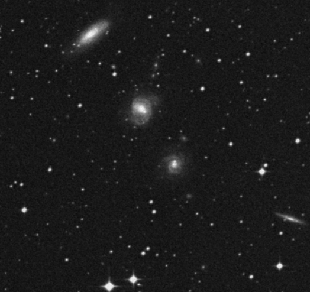
6/23/04:3:00 A.M., CDT. A super night!
Limiting magnitude, 6.2 at zenith! Since
it was so transparent, I decided to try
for this very faint galaxy group in
Aquarius. To my delight, they WERE
visible (but required averted vision).
This trio forms a compact group which
angles from NE to SW. All three
galaxies are 14th mag. and are VERY
faint! From north to south they are:
NGC-6978, 6977, and 6966. 6978 is
lens-shaped, oriented NW to SE, and
is about 1.5' X .5' 6977 is slightly oval
and is just over 1' dia. 6976 is the
smallest. This group is also called
Hickson 88. Observed at 140X (20mm
Nagler Type 2.) Image courtesy of the
Digital Sky Survey.
Limiting magnitude, 6.2 at zenith! Since
it was so transparent, I decided to try
for this very faint galaxy group in
Aquarius. To my delight, they WERE
visible (but required averted vision).
This trio forms a compact group which
angles from NE to SW. All three
galaxies are 14th mag. and are VERY
faint! From north to south they are:
NGC-6978, 6977, and 6966. 6978 is
lens-shaped, oriented NW to SE, and
is about 1.5' X .5' 6977 is slightly oval
and is just over 1' dia. 6976 is the
smallest. This group is also called
Hickson 88. Observed at 140X (20mm
Nagler Type 2.) Image courtesy of the
Digital Sky Survey.
7/19/04: 2:30 A.M., CDT, Using C-11
with 31mm Nagler Type 5 & Lumicon
O-III Filter (90X): Observed emission
nebula NGC-7635 in Cassiopeia, which
is located just SW of M-52. This is a
VERY faint nebula...the only portion
observed was centered on the star that
forms the north apex of a flat triangle of
3 stars. Appears to be about 5 to 6
arc-minutes in extent. This nebula is
often called the Bubble Nebula. Image
taken at Land of Oz Observatory on
July 29, 2014 using the C-11, HyperStar
and the SXVR-H694C color imager
Copyright Ron Abbott, 2014.
with 31mm Nagler Type 5 & Lumicon
O-III Filter (90X): Observed emission
nebula NGC-7635 in Cassiopeia, which
is located just SW of M-52. This is a
VERY faint nebula...the only portion
observed was centered on the star that
forms the north apex of a flat triangle of
3 stars. Appears to be about 5 to 6
arc-minutes in extent. This nebula is
often called the Bubble Nebula. Image
taken at Land of Oz Observatory on
July 29, 2014 using the C-11, HyperStar
and the SXVR-H694C color imager
Copyright Ron Abbott, 2014.
8/15/04: 2:10 A.M., CDT, Using C-11
with 31mm Nagler Type 5 & Lumicon
O-III Filter (90X): Observed supernova
remnant NGC-6960, the Veil Nebula in
Cygnus. Transparency is extremely
good tonight, and with the Oxygen III
filter, this western arc of the Veil
stands out very clearly. Much
filamentary detail is seen, both in the
arc above the star 52 Cygni and below
it in the broader portion of the nebula.
The two smaller patches of nebulosity
which lie between 6960 and the
eastern portion (NGC-6992) were also
clearly seen. Beautiful! (Image taken at
Land of Oz Observatory on the night of
July 14, 2012 using the C-11 at f/2 and
the SXVR-H694C CCD imager.
with 31mm Nagler Type 5 & Lumicon
O-III Filter (90X): Observed supernova
remnant NGC-6960, the Veil Nebula in
Cygnus. Transparency is extremely
good tonight, and with the Oxygen III
filter, this western arc of the Veil
stands out very clearly. Much
filamentary detail is seen, both in the
arc above the star 52 Cygni and below
it in the broader portion of the nebula.
The two smaller patches of nebulosity
which lie between 6960 and the
eastern portion (NGC-6992) were also
clearly seen. Beautiful! (Image taken at
Land of Oz Observatory on the night of
July 14, 2012 using the C-11 at f/2 and
the SXVR-H694C CCD imager.
11/6/04: 9:30 P.M.,CST: Observed the
Pegasus I Galaxy Group using the
11-inch Celestron with 31mm TeleVue
Nagler Type 5 (90X): In the photo below,
the bright galaxy in the center of the
group is NGC-7619, an 11th magnitude
elliptical galaxy. About 9 arcminutes to the
east (left) is NGC-7626, another 11th
mag. elliptical. These two galaxies are the
brightest members of the big Pegasus I
cluster. About 12 arcminutes further east
(left) is the lens-shaped spiral galaxy,
NGC-7631. Visually, it is quite a bit
fainter than the two bright ellipticals.
North (up) of the 7619-7626 pair is
NGC-7623. To the SW of NGC 7619 are
two fainter galaxies, NGC 7617 (very
faint) and further on is NGC-7611 (the
brightest of the two). These six galaxies
are visible in the same field thru the C-11.
NOTE: Image taken 9/22/14 at Land of Oz
Observatory. A 1 hour 48 min. exposure
through the C-11 @ f/2. Copyright 2014,
Ron Abbott.
Pegasus I Galaxy Group using the
11-inch Celestron with 31mm TeleVue
Nagler Type 5 (90X): In the photo below,
the bright galaxy in the center of the
group is NGC-7619, an 11th magnitude
elliptical galaxy. About 9 arcminutes to the
east (left) is NGC-7626, another 11th
mag. elliptical. These two galaxies are the
brightest members of the big Pegasus I
cluster. About 12 arcminutes further east
(left) is the lens-shaped spiral galaxy,
NGC-7631. Visually, it is quite a bit
fainter than the two bright ellipticals.
North (up) of the 7619-7626 pair is
NGC-7623. To the SW of NGC 7619 are
two fainter galaxies, NGC 7617 (very
faint) and further on is NGC-7611 (the
brightest of the two). These six galaxies
are visible in the same field thru the C-11.
NOTE: Image taken 9/22/14 at Land of Oz
Observatory. A 1 hour 48 min. exposure
through the C-11 @ f/2. Copyright 2014,
Ron Abbott.
4/13/05: Another SUPER night at Oz!
One of my best observations for the
night was the compact galaxy group
Hickson 56. This elusive object lies
about 8 arcminutes south of galaxy
NGC-3718 in Ursa Major. In the image
at the right, it can be seen as a
compact group of 5 tiny galaxies in a
space only 2.5 arcminutes in extent.
This field also shows tremendous
depth of field, because the galaxies in
Hickson 56 lie at a distance of 450
million light years. NGC-3718 is 40
million light years distant.
Using the 16mm Nagler eyepiece
(175X) and averted vision, I was able
to pick out the nucleii of the three
brightest members of Hickson 56. This
group is one of the target items in the
A.L. Galaxy Groups & Clusters
Program. Image taken at Land of Oz
Observatory on May 21, 2017.
One of my best observations for the
night was the compact galaxy group
Hickson 56. This elusive object lies
about 8 arcminutes south of galaxy
NGC-3718 in Ursa Major. In the image
at the right, it can be seen as a
compact group of 5 tiny galaxies in a
space only 2.5 arcminutes in extent.
This field also shows tremendous
depth of field, because the galaxies in
Hickson 56 lie at a distance of 450
million light years. NGC-3718 is 40
million light years distant.
Using the 16mm Nagler eyepiece
(175X) and averted vision, I was able
to pick out the nucleii of the three
brightest members of Hickson 56. This
group is one of the target items in the
A.L. Galaxy Groups & Clusters
Program. Image taken at Land of Oz
Observatory on May 21, 2017.

2/22/06: Succeeded in making a visual
observation of the new supernova
(2006X) in the spiral galaxy M-100
(NGC-4321) in Coma Berenices. Using
the C-11 at 140X (20mm Nagler II) the
supernova flitted in and out of view with
direct vision, but could be held steadily
with averted vision. It appeared to be
about half a magnitude fainter than the
two stars that frame it, one at the WSW
edge of the galaxy and the other at the
ESE edge of the galaxy. The faint
spiral arm that curves just south of the
super nova was clearly seen. The
image of 2006X to the right was taken
by my friend, Dave Hudgins at his
Starbase Observatory in Overland
Park, Kansas, using a Meade 10"
LX200 and an SBIG ST-7 CCD
camera. (copyright 2006, David
Hudgins). For reference purposes, I
have also included a picture of M-100
which was taken on 6/5/18 through
the C-11 at f/2 using the HyperStar 3
system and the SXVR H-694C CCD
camera. Captured and combined using
Maxim DL 5 Pro.Post-processed using
Photoshop CS.Copyright 2012, Ron
Abbott.
observation of the new supernova
(2006X) in the spiral galaxy M-100
(NGC-4321) in Coma Berenices. Using
the C-11 at 140X (20mm Nagler II) the
supernova flitted in and out of view with
direct vision, but could be held steadily
with averted vision. It appeared to be
about half a magnitude fainter than the
two stars that frame it, one at the WSW
edge of the galaxy and the other at the
ESE edge of the galaxy. The faint
spiral arm that curves just south of the
super nova was clearly seen. The
image of 2006X to the right was taken
by my friend, Dave Hudgins at his
Starbase Observatory in Overland
Park, Kansas, using a Meade 10"
LX200 and an SBIG ST-7 CCD
camera. (copyright 2006, David
Hudgins). For reference purposes, I
have also included a picture of M-100
which was taken on 6/5/18 through
the C-11 at f/2 using the HyperStar 3
system and the SXVR H-694C CCD
camera. Captured and combined using
Maxim DL 5 Pro.Post-processed using
Photoshop CS.Copyright 2012, Ron
Abbott.
7/23/06: Observed this very interesting
galaxy group in Serpens Caput. These
three galaxies provide a great study in
visual contrast. The galaxies in the upper
left hand corner of the image are
NGC-5954 (left) and NGC-5953
(right). The galaxy to the lower right
hand corner is NGC-5951. All three
are spirals. 5953 and 5954 are almost
in contact. Although 5954 is larger,
5953 stands out better due to its bright
concentrated core. NGC-5951 is the
most elusive of the three, but is quite
striking due to its extended nature. It
appears as a very faint sliver of even
surface brightness. All three fit in the
field of the 140X 20mm Nagler eyepiece.
(Photo courtesy of Digital Sky Survey).
galaxy group in Serpens Caput. These
three galaxies provide a great study in
visual contrast. The galaxies in the upper
left hand corner of the image are
NGC-5954 (left) and NGC-5953
(right). The galaxy to the lower right
hand corner is NGC-5951. All three
are spirals. 5953 and 5954 are almost
in contact. Although 5954 is larger,
5953 stands out better due to its bright
concentrated core. NGC-5951 is the
most elusive of the three, but is quite
striking due to its extended nature. It
appears as a very faint sliver of even
surface brightness. All three fit in the
field of the 140X 20mm Nagler eyepiece.
(Photo courtesy of Digital Sky Survey).


8/24/06: At 4:10 a.m. CDT, observed
this faint galaxy trio in Andromeda. This
is the NGC-48 group. From left (east)
to right (west), the galaxies are:
NGC-51 (the brightest of the group)
NGC-49, and NGC-48. NGC-51 lies
approximately 2 arcminutes NE of an
approximately 10.5 magnitude star.
NGC-49 lies approximately 2 arcmin-
utes NW of the same star, and NGC
48 lies approximately 4 arcminutes
WSW of NGC-49. NGC-48 has the
lowest surface brightness of the three,
and is just barely visible using averted
vision. All three are small and faint.
This group is one of the targets of the
Astronomical League's "Galaxy Groups
and Clusters" program. (Photo
courtesy of Digital Sky Survey).
this faint galaxy trio in Andromeda. This
is the NGC-48 group. From left (east)
to right (west), the galaxies are:
NGC-51 (the brightest of the group)
NGC-49, and NGC-48. NGC-51 lies
approximately 2 arcminutes NE of an
approximately 10.5 magnitude star.
NGC-49 lies approximately 2 arcmin-
utes NW of the same star, and NGC
48 lies approximately 4 arcminutes
WSW of NGC-49. NGC-48 has the
lowest surface brightness of the three,
and is just barely visible using averted
vision. All three are small and faint.
This group is one of the targets of the
Astronomical League's "Galaxy Groups
and Clusters" program. (Photo
courtesy of Digital Sky Survey).
 | |  | |  | |  | |  |

4/19/07: At 12:20AM, Observed this
very faint group of galaxies in Leo.
The brightest member of the group is
the inclined spiral galaxy NGC-2929,
which is the southern-most galaxy in
the group(centerof photo). NGC-2929
is 14th magnitude and approximately 1
X 1/2 arcminutes in size, inclined from
northwest to southeast. Through the
C-11 at 233X (12mm Nagler)it appears
as a faint amorphous oval smudge of
light, which requires averted vision to
see well.The 7.5 magnitude star
SAO80931 lies 1/2 field to the SW
(lowerright hand corner of photo).
Only one other member of this faint
group was seen, NGC-2931, which is
the middle member of the group, just 3
arcminutes north of 2929. It is small
(about 1/2 armin. diameter) very faint,
round, with even surface brightness.
This is one of the galaxy groups in
the Astronomical League's "Galaxy
Groups and Clusters" observing
program, of which I have completed
about 2/3 of the observations. (Image
courtesy of the Digital Sky Survey).
very faint group of galaxies in Leo.
The brightest member of the group is
the inclined spiral galaxy NGC-2929,
which is the southern-most galaxy in
the group(centerof photo). NGC-2929
is 14th magnitude and approximately 1
X 1/2 arcminutes in size, inclined from
northwest to southeast. Through the
C-11 at 233X (12mm Nagler)it appears
as a faint amorphous oval smudge of
light, which requires averted vision to
see well.The 7.5 magnitude star
SAO80931 lies 1/2 field to the SW
(lowerright hand corner of photo).
Only one other member of this faint
group was seen, NGC-2931, which is
the middle member of the group, just 3
arcminutes north of 2929. It is small
(about 1/2 armin. diameter) very faint,
round, with even surface brightness.
This is one of the galaxy groups in
the Astronomical League's "Galaxy
Groups and Clusters" observing
program, of which I have completed
about 2/3 of the observations. (Image
courtesy of the Digital Sky Survey).
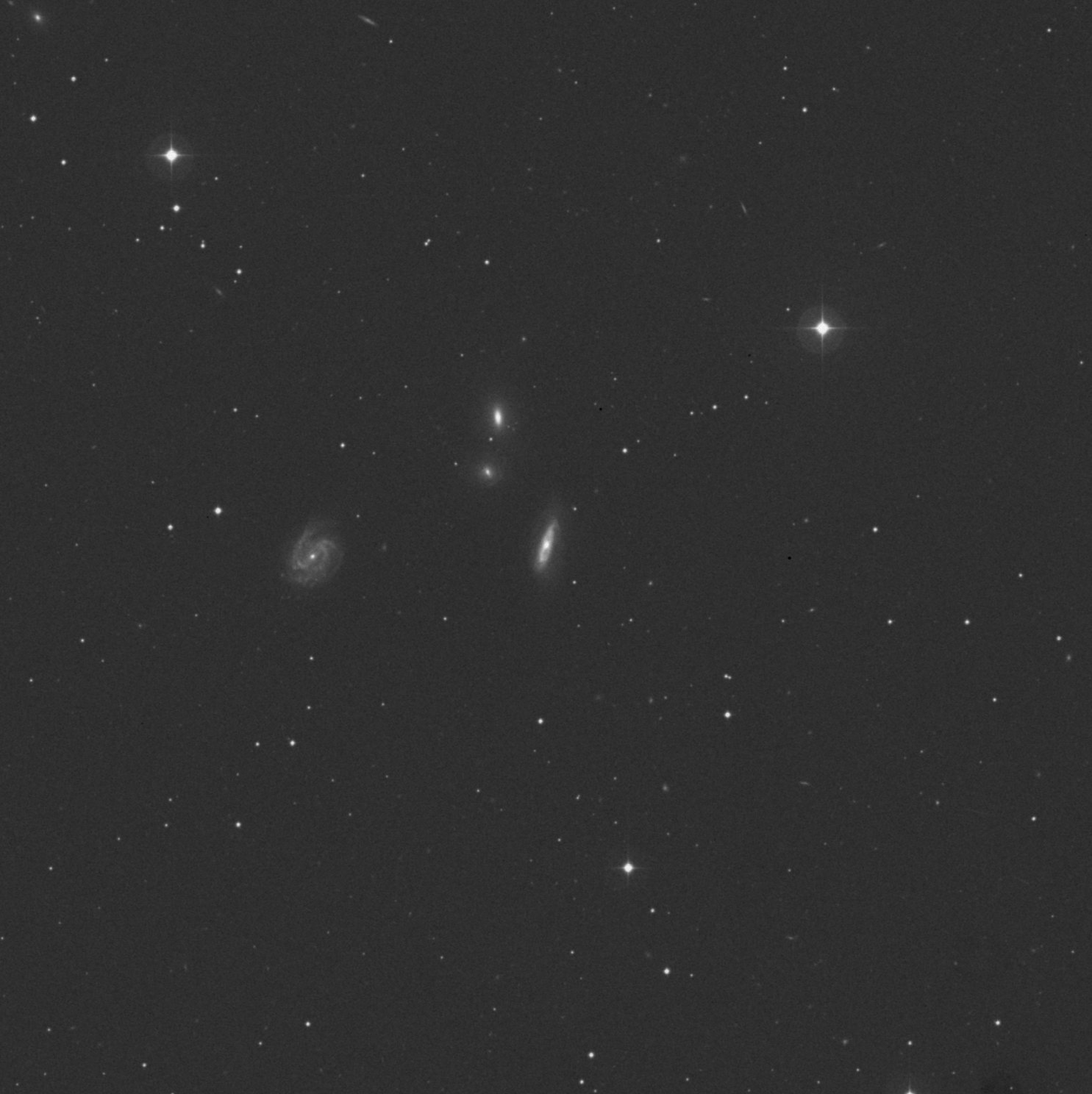
10/11/07: At 11:55PM, observed galaxy
group Hickson 7 in Cetus the whale.The
brightest member of this group is the
spiral galaxy NGC-192, a lens-shaped
galaxy which lies at the lower right of this
triangular group. It is approximately 2
arcminutes by 1/2 arcminute in size and
is 13.4 magnitude. 3 arcminutes to the
NNE lies NGC-196, a 13.8 magnitude
spiral which is about 1.5 arcminutes in
size. The faint galaxy between them in
the photo at right, NGC- 197, is 15th
magnitude, and was not seen.
About 5 arcminutes to the east (left) of
NGC-192is the face-on spiral NGC-201
Visually it is large and diffuse and of
even surface brightness. NGC-192 is
also known as Hickson 7a, NGC-196 as
7b, and NGC-201 as 7c. This group is in
theAstronomical League's Galaxy
Groups & Clusters program. This group
was observed using the C-11 at
175X. Limiting magnitude tonight was
6.0.(Image courtesy of the Digital Sky
Survey).
group Hickson 7 in Cetus the whale.The
brightest member of this group is the
spiral galaxy NGC-192, a lens-shaped
galaxy which lies at the lower right of this
triangular group. It is approximately 2
arcminutes by 1/2 arcminute in size and
is 13.4 magnitude. 3 arcminutes to the
NNE lies NGC-196, a 13.8 magnitude
spiral which is about 1.5 arcminutes in
size. The faint galaxy between them in
the photo at right, NGC- 197, is 15th
magnitude, and was not seen.
About 5 arcminutes to the east (left) of
NGC-192is the face-on spiral NGC-201
Visually it is large and diffuse and of
even surface brightness. NGC-192 is
also known as Hickson 7a, NGC-196 as
7b, and NGC-201 as 7c. This group is in
theAstronomical League's Galaxy
Groups & Clusters program. This group
was observed using the C-11 at
175X. Limiting magnitude tonight was
6.0.(Image courtesy of the Digital Sky
Survey).

10/12/07: At 1:00AM, Observed the
interesting group of galaxies pictured to the
right. This is the NGC-80 group in the
constellation of Andromeda. The brightest
member of the group is the SO-type spiral
galaxy NGC-80, which appears just belowand
to the right (west) of the center of thephoto.
Visually this galaxy appears round with
diffuse outer edges and a halo that brightens
suddenly to a compressed core. It appears to
be about 1.2 arcminutes in diameter. About 5
arcminutes to the NE(up and to the left) of
NGC-80 is NGC-83, a 13.5 magnitude
elliptical galaxy. It is smaller and fainter than
NGC-80 and has even surface brightness.
About 7 arc minutes due east (left) of
NGC-83 lies NGC-93 an SO-type spiral.
NGC-93 was the faintest of three. The other
galaxies in the photo are 15th magnitude and
fainter and were not seen visually. (Photo
courtesy of the Digital Sky Survey).
interesting group of galaxies pictured to the
right. This is the NGC-80 group in the
constellation of Andromeda. The brightest
member of the group is the SO-type spiral
galaxy NGC-80, which appears just belowand
to the right (west) of the center of thephoto.
Visually this galaxy appears round with
diffuse outer edges and a halo that brightens
suddenly to a compressed core. It appears to
be about 1.2 arcminutes in diameter. About 5
arcminutes to the NE(up and to the left) of
NGC-80 is NGC-83, a 13.5 magnitude
elliptical galaxy. It is smaller and fainter than
NGC-80 and has even surface brightness.
About 7 arc minutes due east (left) of
NGC-83 lies NGC-93 an SO-type spiral.
NGC-93 was the faintest of three. The other
galaxies in the photo are 15th magnitude and
fainter and were not seen visually. (Photo
courtesy of the Digital Sky Survey).
6/1/08: During the first observing
session since receiving my factory
overhauled C-11 Telescope back from
the Celestron factory, I had the
occasion to make a detailed visual
observation of NGC-3184, a distant
face-on spiral galaxy in the
constellation of Ursa Major. I observed
the galaxy at magnifications of 70X
(40mm TeleVue Wide-Field eyepiece)
and 140X(Televue 20mm Nagler). At
70X, the bright star Mu Ursae Majoris,
to the east, has to be positioned out of
the field for the best view. At 140X, a
faint, almost stellar nucleus appears
within the oval core, and a 12th
magnitude star twinkles at the north
edge of the outer haze, which is
uneven in brightness, indicating a hint
of two spiral arms. The image at right
was taken on 3/15/13 through the C-11
at f/2 using the HyperStar imaging
system and the Starlight Express SXVR
H-694C color CCD imager.
session since receiving my factory
overhauled C-11 Telescope back from
the Celestron factory, I had the
occasion to make a detailed visual
observation of NGC-3184, a distant
face-on spiral galaxy in the
constellation of Ursa Major. I observed
the galaxy at magnifications of 70X
(40mm TeleVue Wide-Field eyepiece)
and 140X(Televue 20mm Nagler). At
70X, the bright star Mu Ursae Majoris,
to the east, has to be positioned out of
the field for the best view. At 140X, a
faint, almost stellar nucleus appears
within the oval core, and a 12th
magnitude star twinkles at the north
edge of the outer haze, which is
uneven in brightness, indicating a hint
of two spiral arms. The image at right
was taken on 3/15/13 through the C-11
at f/2 using the HyperStar imaging
system and the Starlight Express SXVR
H-694C color CCD imager.
9/27/08: At 2:30 AM, observed NGC-7640,
a striking edge-on barred spiral galaxy in
Andromeda. Observed at 70X (41mm
Panoptic) and 140X (20mm Nagler T2).
The galaxy is superimposed upon a tight
triangle of 11th magnitude stars. At 70X,
the galaxy appears as a faint streak
running through the triangle of stars from
NNW to SSE, surrounded by a starry field.
The galaxy's outer envelope is very diffuse
and tenuous and brightens gradually to an
elongated core in the same PA as the
outer envelope. At 140X (20mm Nagler)
the galaxy appears as a 7' X 1.5' streak
extending from just beyond the southern
star of the triangle and about 2 arcminutes
N of the northern star. A faint star is super-
imposed upon the north tip of the galaxy.
The core shows uneven brightness with a
star superimposed upon the W edge of
the nucleus. Image taken at Land of Oz
Observatory on August 31, 2014.
Copyright Ron Abbott 2014.
a striking edge-on barred spiral galaxy in
Andromeda. Observed at 70X (41mm
Panoptic) and 140X (20mm Nagler T2).
The galaxy is superimposed upon a tight
triangle of 11th magnitude stars. At 70X,
the galaxy appears as a faint streak
running through the triangle of stars from
NNW to SSE, surrounded by a starry field.
The galaxy's outer envelope is very diffuse
and tenuous and brightens gradually to an
elongated core in the same PA as the
outer envelope. At 140X (20mm Nagler)
the galaxy appears as a 7' X 1.5' streak
extending from just beyond the southern
star of the triangle and about 2 arcminutes
N of the northern star. A faint star is super-
imposed upon the north tip of the galaxy.
The core shows uneven brightness with a
star superimposed upon the W edge of
the nucleus. Image taken at Land of Oz
Observatory on August 31, 2014.
Copyright Ron Abbott 2014.
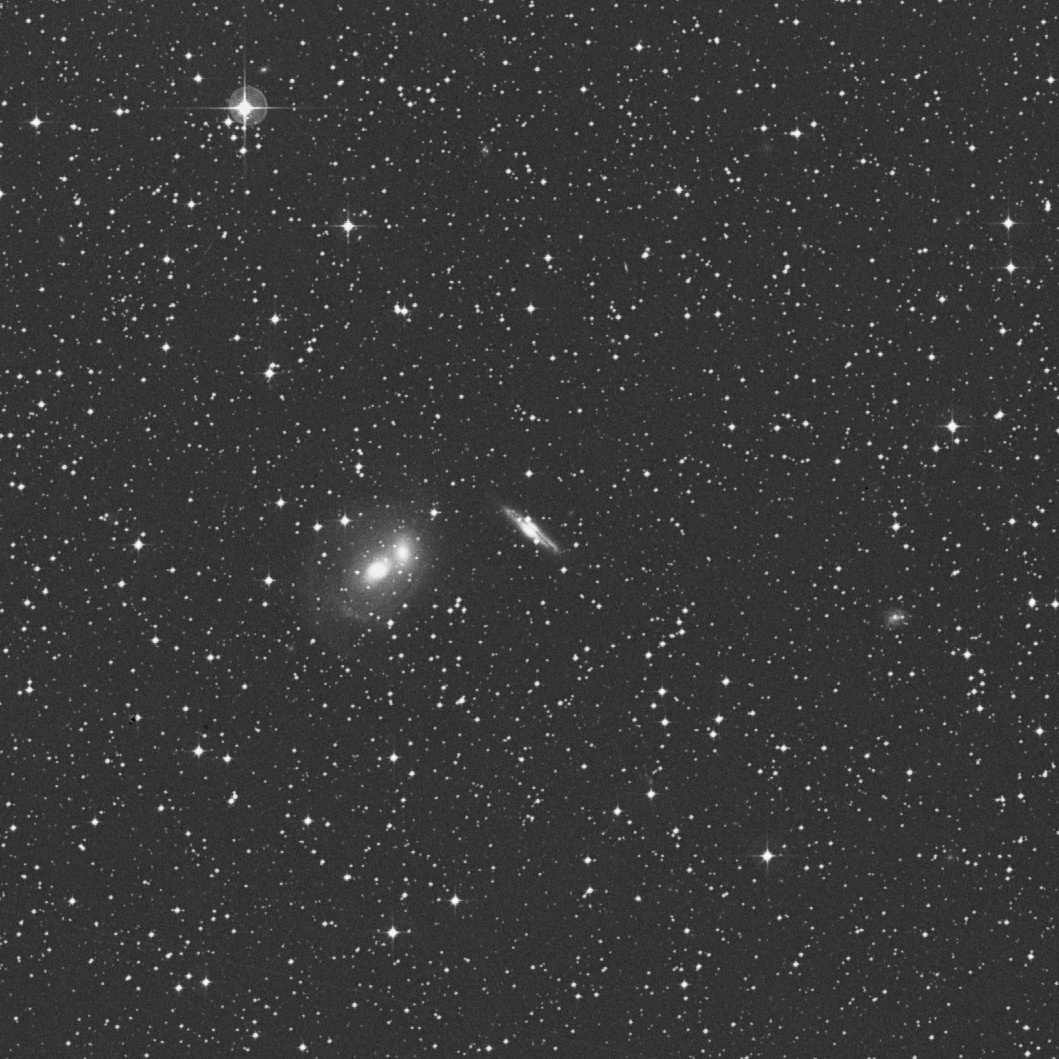
12/30/08: Observed an interesting trio of
faint galaxies in Canis Major. This is the
NGC-2292,93,95 group of galaxies. The
interacting pair to the left (east) is NGC
2293 and 2292 (to the right, or west).
Both galaxies are ellipticals. 2293, the
larger galaxy, is approximately 2.5' on its
long dimension, oriented NW to SE, and
is magnitude 13.0. NGC-2292 is slightly
smaller, about 2 arcminutes, and is
oriented north to south. It is 13.8 mag.
Using the C-11 at 140X, the two galaxies
are merged, forming an oblong smudge
with a brighter center,oriented NW to SE.
About 5 arcminutes west of NGC-2292
lies NGC-2295, a faint edge-on spiral
galaxy. Through the C-11 at 140X it
appears as a very faint elliptical blob of
even surface brightness, oriented from
NE to SW.The brighter pair of galaxies is
visible with direct vision, but the edge-on
2295 requires averted vision to see. This
trio is part of the A.L. Galaxy Groups and
Clusters program. (Photo courtesy of
Digital Sky Survey).
faint galaxies in Canis Major. This is the
NGC-2292,93,95 group of galaxies. The
interacting pair to the left (east) is NGC
2293 and 2292 (to the right, or west).
Both galaxies are ellipticals. 2293, the
larger galaxy, is approximately 2.5' on its
long dimension, oriented NW to SE, and
is magnitude 13.0. NGC-2292 is slightly
smaller, about 2 arcminutes, and is
oriented north to south. It is 13.8 mag.
Using the C-11 at 140X, the two galaxies
are merged, forming an oblong smudge
with a brighter center,oriented NW to SE.
About 5 arcminutes west of NGC-2292
lies NGC-2295, a faint edge-on spiral
galaxy. Through the C-11 at 140X it
appears as a very faint elliptical blob of
even surface brightness, oriented from
NE to SW.The brighter pair of galaxies is
visible with direct vision, but the edge-on
2295 requires averted vision to see. This
trio is part of the A.L. Galaxy Groups and
Clusters program. (Photo courtesy of
Digital Sky Survey).
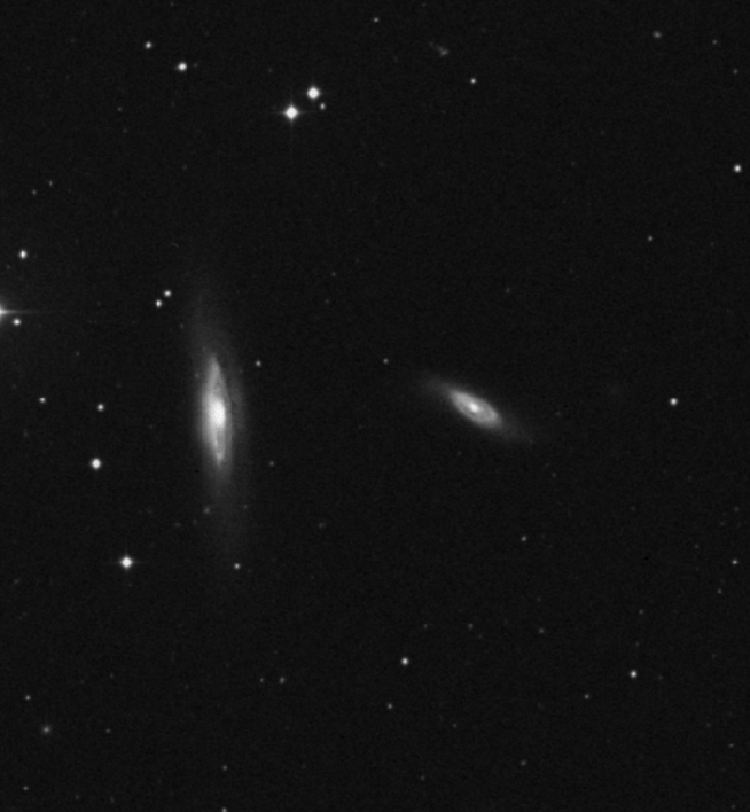
5/20/09: 1:55AM, observed this pair of
galaxies in Ursa Major. The larger spiral
galaxy to the left (east) is NGC-5389. It
is 13th magnitude and is approximately
4 arcminutes in length, oriented N to S.
Just 3 arcminutes to the right (west) is
the smaller, fainter spiral, NGC-5379. It
is approximately 2 arcminutes in extent,
oval, oriented ENE to WSW. It is 13.5
magnitude. Both galaxies are visible with
direct vision through the C-11 at 140X.
A very nice pair. (Image courtesy of
the Digital Sky Survey).
galaxies in Ursa Major. The larger spiral
galaxy to the left (east) is NGC-5389. It
is 13th magnitude and is approximately
4 arcminutes in length, oriented N to S.
Just 3 arcminutes to the right (west) is
the smaller, fainter spiral, NGC-5379. It
is approximately 2 arcminutes in extent,
oval, oriented ENE to WSW. It is 13.5
magnitude. Both galaxies are visible with
direct vision through the C-11 at 140X.
A very nice pair. (Image courtesy of
the Digital Sky Survey).
5/6/2010: 1:45AM, Observed this galaxy
group in Coma Berenices known as
Hickson 61, or "The Box". The group
consists of NGC-4169, the bright
elliptical galaxy at the lower right-hand
corner of the box(13.2 mag.) At the
upper left hand corner is the next
brightest galaxy, NGC-4175, a 13.9 mag.
edge-on spiral with a nuclear bulge. The
next brightest galaxy is NGC-4174, a
very small 14.1 mag. spiral at the upper
right hand corner. The very faintest
member of this group is the large, vague
edge-on spiral, NGC-4173, at the lower
left hand corner. Though listed at 12.6
magnitude, it is visually the faintest of
the foursome, due to its extended size.
Seeing all four required averted vision
and 233X and EXCELLENT sky
transparency. Image taken 4/23/12 at
Land of Oz, using the C-11 @ f/2 using
the HyperStar 3 imaging system.
group in Coma Berenices known as
Hickson 61, or "The Box". The group
consists of NGC-4169, the bright
elliptical galaxy at the lower right-hand
corner of the box(13.2 mag.) At the
upper left hand corner is the next
brightest galaxy, NGC-4175, a 13.9 mag.
edge-on spiral with a nuclear bulge. The
next brightest galaxy is NGC-4174, a
very small 14.1 mag. spiral at the upper
right hand corner. The very faintest
member of this group is the large, vague
edge-on spiral, NGC-4173, at the lower
left hand corner. Though listed at 12.6
magnitude, it is visually the faintest of
the foursome, due to its extended size.
Seeing all four required averted vision
and 233X and EXCELLENT sky
transparency. Image taken 4/23/12 at
Land of Oz, using the C-11 @ f/2 using
the HyperStar 3 imaging system.


5/12/2015: 10:30 P.M., CDT, Using the
C-11 with 16mm Nagler T-II (175X):
Observed the faintest galaxy I have
yet seen visually, the edge-on spiral
NGC-3196, a galaxy in Leo. At 175X,
this galaxy is very small, very faint, an
edge on sliver of even surface
brightness which requires averted
vision to detect. MegaStar says this
galaxy is only 1/2 arc minute on its
long axis, which is oriented from NW to
SE. A 14.9 mag.star, GSC-1975:1365,
lies just 1 arc minute to the east. NGC,
DSS, and MegaStar list this galaxy at
15.7 mag. , making it the faintest deep
sky object I have yet observed. Image
at right is courtesy of The Deep Sky
Survey.
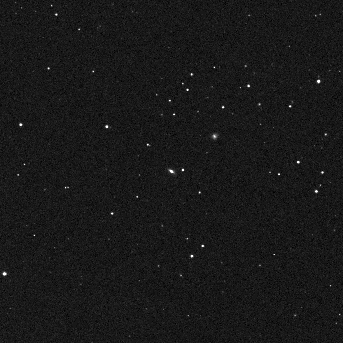
C-11 with 16mm Nagler T-II (175X):
Observed the faintest galaxy I have
yet seen visually, the edge-on spiral
NGC-3196, a galaxy in Leo. At 175X,
this galaxy is very small, very faint, an
edge on sliver of even surface
brightness which requires averted
vision to detect. MegaStar says this
galaxy is only 1/2 arc minute on its
long axis, which is oriented from NW to
SE. A 14.9 mag.star, GSC-1975:1365,
lies just 1 arc minute to the east. NGC,
DSS, and MegaStar list this galaxy at
15.7 mag. , making it the faintest deep
sky object I have yet observed. Image
at right is courtesy of The Deep Sky
Survey.

10/15/15: 12:45 A.M., CDT, Using the
C-11 with 12mm TeleVue Nagler Type
IV (233X): Seeing tonight was quite
good, steady, with a SQM reading of
21.25. For the very first time, I was
able to observe the very faint outlier of
the "Stephan's Quintet" group of
galaxies. This is the very small face-on
galaxy NGC-7320-C, also known as
PGC-69346. Although it is listed at
15th magnitude, I was able to see it
using averted vision, due to its bright,
concentrated core. It is very faint and
small, less than 1/2 arc minute in dia.
In this image it is the small galaxy just
inside the left center of the image. This
image of Stephan's Quintet was taken
at Land of Oz Observatory with the
C-11 @ f/2 using HyperStar and the
Starlight Xpress SXVR-H694C imager.
Total exposure time was 1 hour.
Copyright Ron Abbott 2014.
C-11 with 12mm TeleVue Nagler Type
IV (233X): Seeing tonight was quite
good, steady, with a SQM reading of
21.25. For the very first time, I was
able to observe the very faint outlier of
the "Stephan's Quintet" group of
galaxies. This is the very small face-on
galaxy NGC-7320-C, also known as
PGC-69346. Although it is listed at
15th magnitude, I was able to see it
using averted vision, due to its bright,
concentrated core. It is very faint and
small, less than 1/2 arc minute in dia.
In this image it is the small galaxy just
inside the left center of the image. This
image of Stephan's Quintet was taken
at Land of Oz Observatory with the
C-11 @ f/2 using HyperStar and the
Starlight Xpress SXVR-H694C imager.
Total exposure time was 1 hour.
Copyright Ron Abbott 2014.

11/3/16: 9:00PM. With a Sky Quality Meter reading
of 21.3, I was able to have a very good observation
of the FORNAX GALAXY CLUSTER. This cluster
of galaxies lies on the border of the constellations
Eridanus and Fornax, at a southern declination of
35 degrees. The good transparency, and the fact
that this group was near the meridian helped
deliver a quality view. This group of over 15
galaxies is anchored by the two giant elliptical
galaxies, NGC-1399 and 1404, prominent in the
image at the lower left hand corner. Up at the NW
edge of the cluster (upper right) lies the large spiral
galaxy, NGC-1380. In addition to other bright
members such as NGC's 1387 and 1379 (at the
lower right hand portion of the image) there are
many other smaller faint galaxies. Over 15 are
visible in this image, which was taken later the same
evening. Using the 31mm Nagler (90X) most of the
galaxies in this image are visible in the same field.
An annotated version of this image can be found on
the Latest Images page of this website.
NOTE: This image is a 1 hour exposure (10X6
minutesubs) taken through the C-11 at f/2 using the
HyperStar 3 imaging system and the
StarlightXpress SXVRH-694C one-shot color CCD
imager. Guided, capturedand combined using
Maxim DL5 Pro. Post-processed using
PhotoShopCS2, levels, curves, AstroTools,Gradient
X-Terminator and StarShrink. Copyright Ron
Abbott 2017.
of 21.3, I was able to have a very good observation
of the FORNAX GALAXY CLUSTER. This cluster
of galaxies lies on the border of the constellations
Eridanus and Fornax, at a southern declination of
35 degrees. The good transparency, and the fact
that this group was near the meridian helped
deliver a quality view. This group of over 15
galaxies is anchored by the two giant elliptical
galaxies, NGC-1399 and 1404, prominent in the
image at the lower left hand corner. Up at the NW
edge of the cluster (upper right) lies the large spiral
galaxy, NGC-1380. In addition to other bright
members such as NGC's 1387 and 1379 (at the
lower right hand portion of the image) there are
many other smaller faint galaxies. Over 15 are
visible in this image, which was taken later the same
evening. Using the 31mm Nagler (90X) most of the
galaxies in this image are visible in the same field.
An annotated version of this image can be found on
the Latest Images page of this website.
NOTE: This image is a 1 hour exposure (10X6
minutesubs) taken through the C-11 at f/2 using the
HyperStar 3 imaging system and the
StarlightXpress SXVRH-694C one-shot color CCD
imager. Guided, capturedand combined using
Maxim DL5 Pro. Post-processed using
PhotoShopCS2, levels, curves, AstroTools,Gradient
X-Terminator and StarShrink. Copyright Ron
Abbott 2017.
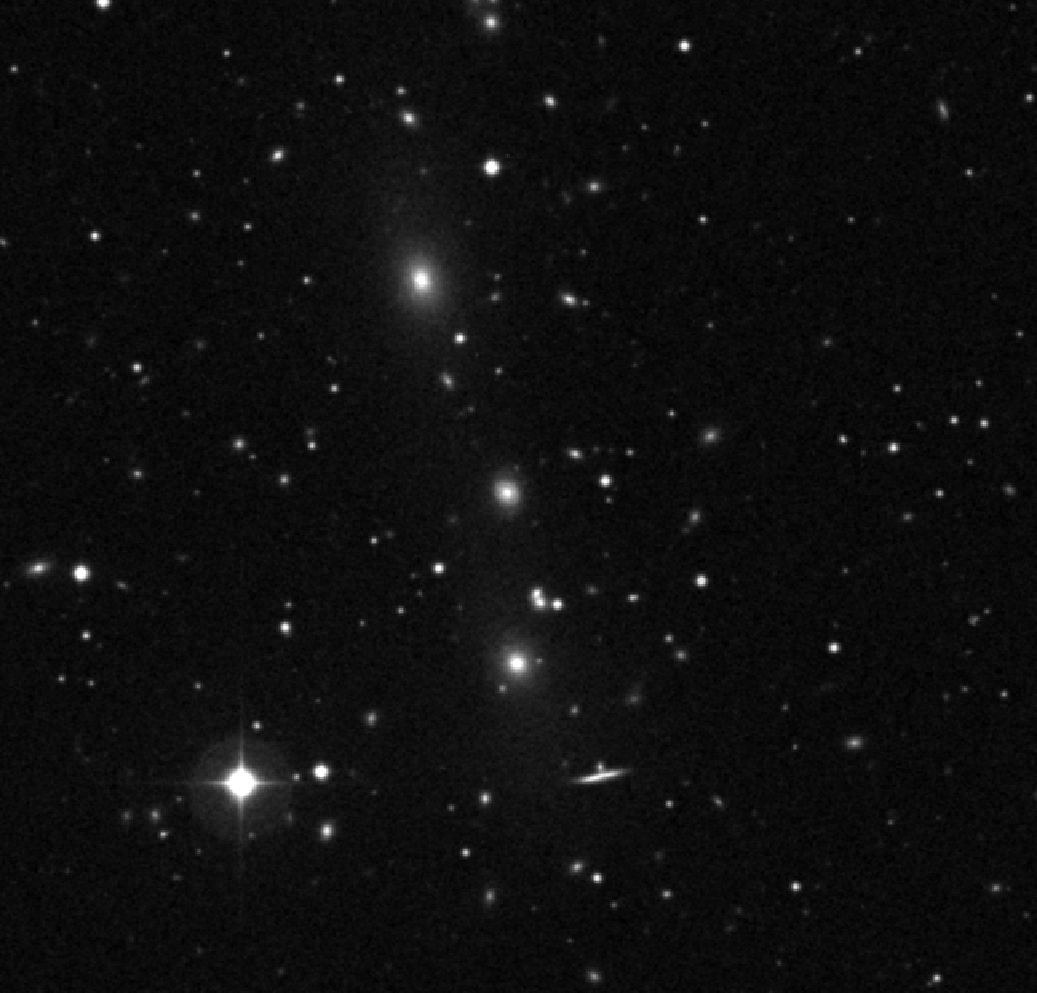
JULY 8, 2018: On a very clear, dark
evening (SQM-L reading: 21.58) I
succeeded in observing the brightest
members of the faint galaxy cluster,
Abell 2147, in Hercules. The bright
star in the lower LH (east) side of the
image is 9th magnitude SAO-101886.
The brightest galaxy in this image is
UGC-10143, the northernmost galaxy
in this image. It is a 14.2 magnitude
elliptical galaxy. The galaxy just to the
south, in the center of the image, is
CGCG-108-71, a 14.1 magnitude
elliptical galaxy. These two galaxies
were the only members of this faint
cluster visible. The observation was
made using the 11-inch Celestron with
the 14mm Explore Scientific 100 deg.
field eyepiece. the UGC galaxy, while
larger, is fainter than the CGCG galaxy.
Image courtesy of STSCi digital sky
survey.
evening (SQM-L reading: 21.58) I
succeeded in observing the brightest
members of the faint galaxy cluster,
Abell 2147, in Hercules. The bright
star in the lower LH (east) side of the
image is 9th magnitude SAO-101886.
The brightest galaxy in this image is
UGC-10143, the northernmost galaxy
in this image. It is a 14.2 magnitude
elliptical galaxy. The galaxy just to the
south, in the center of the image, is
CGCG-108-71, a 14.1 magnitude
elliptical galaxy. These two galaxies
were the only members of this faint
cluster visible. The observation was
made using the 11-inch Celestron with
the 14mm Explore Scientific 100 deg.
field eyepiece. the UGC galaxy, while
larger, is fainter than the CGCG galaxy.
Image courtesy of STSCi digital sky
survey.

